

Someone gets pulled over on the Fairfax County Parkway on a Friday night. By Saturday morning, they’re not scrolling through ten blue links. They’re typing a full question into ChatGPT, Gemini, or Google: “Who is the best DUI lawyer in Fairfax for a first offense, and how much does it usually cost?” A few seconds later, they have a short answer with two or three firm names.
If your firm isn’t one of those names, you may never know that client existed.
That’s the new challenge for law firms in Northern Virginia. Traditional search still matters, but AI search tools now answer many questions directly and recommend firms by name. This post explains how potential clients use AI to choose a lawyer, what these tools look for when they decide which firms to mention, and the specific website and profile changes that make your firm easier to recommend.
Please note: This article is general marketing information, not legal advice. Every firm should review its website and marketing against its state bar’s advertising rules, including the Virginia State Bar and, if you practice in D.C., the D.C. Bar.
How Potential Clients Use AI to Find a Lawyer
People bring legal problems to AI tools because they feel private and patient. The questions tend to be long, specific, and local:
- “What happens after a first DUI in Virginia, and do I need a lawyer?”
- “Best DUI lawyer in Fairfax who handles cases in Fairfax County General District Court”
- “Divorce lawyer in Arlington who does collaborative divorce”
- “Personal injury attorney near Reston who handles bike accidents and offers free consultations”
- “Estate planning lawyer in McLean who does trusts for blended families”
Each question mixes research (“what happens after a DUI”) with selection (“who should I call”). AI tools answer the research part first, then suggest firms that seem like a good fit. Firms that clearly explain the process, the practice area, and the location are the ones that fit neatly into that answer.
How AI Search Tools Decide Which Firms to Mention
Each platform works differently and changes often, but the broad pattern is consistent enough to plan around.
Google AI Overviews and AI Mode
Google’s AI Overviews appear above regular results for many questions, and since early 2026, searchers can ask a follow-up question right from an AI Overview and continue the conversation in AI Mode. That means a single search can turn into several rounds of questions, with more chances for your firm to be cited, or skipped. Google draws on web pages it already indexes and on local information such as Google Business Profiles, so the basics of local SEO still carry a lot of weight.
ChatGPT and Gemini
ChatGPT and Gemini can search the web when a question needs current or local information, and they can show local business listings alongside their answers. They pull from your website, business directories, review sites, and other public sources. When those sources agree with each other and describe your firm clearly, it’s easier for the tool to mention you with confidence.
What they have in common
Across platforms, AI tools tend to favor firms whose information is:
- Clear: It’s obvious what the firm does, for whom, and where.
- Specific: Practice area pages answer real questions instead of repeating slogans.
- Consistent: The firm’s name, address, phone, attorneys, and practice areas match across the web.
- Trusted: Reviews, bar profiles, and legal directories back up what the website says.
We covered the general shift in more detail in AI Search vs. Traditional Search: What’s Changing in 2026?. The rest of this post applies those ideas specifically to law firms.
What Your Law Firm’s Website Needs for AI Search
1. Practice area pages with real depth
A single “Criminal Defense” page that lists ten charge types in bullet points gives AI tools very little to work with. Instead, create a dedicated page for each practice area or case type you want to be known for, such as DUI/DWI, reckless driving, protective orders, or custody.
A strong practice area page:
- Explains the process in plain English (for example, what happens between a DUI arrest and the first court date in Fairfax County)
- Names the courts and jurisdictions you actually handle
- Describes who the service is for and when someone should call
- Explains your approach without promising outcomes
- Links to the attorneys who handle those cases
These pages help AI tools answer the research half of the question and make your firm a natural fit for the selection half.
2. Attorney bios that match everywhere else
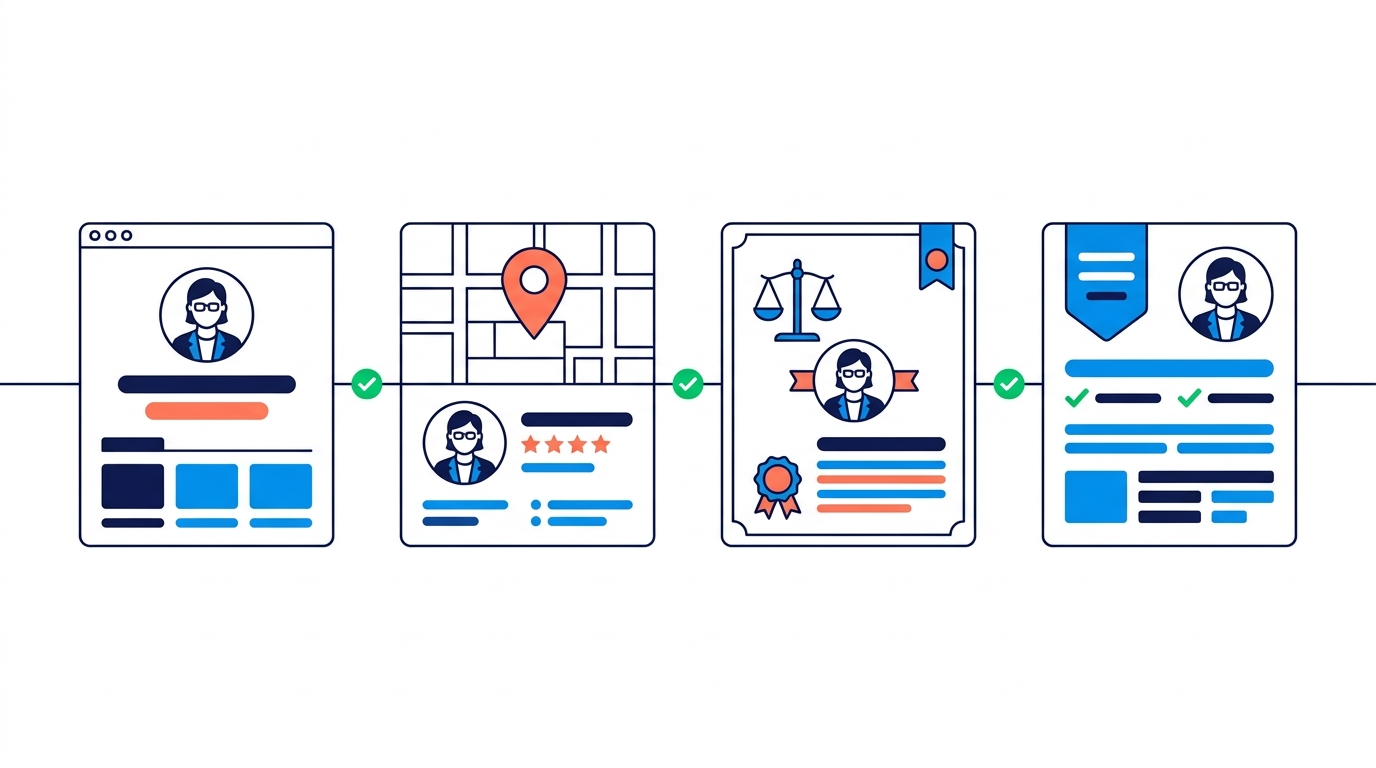
AI tools don’t just evaluate your firm. They also try to understand the individual attorneys. That’s why attorney entity consistency matters. Each attorney’s name, bar admissions, practice areas, and office location should be the same on:
- Your website’s attorney bio page
- Your Google Business Profile (and any individual attorney profiles)
- The Virginia State Bar and D.C. Bar directories, where applicable
- Legal directories such as Avvo, Justia, and Martindale-Hubbell
If one profile lists an attorney as practicing DUI and traffic defense in Fairfax while another still shows a former firm in a different city, AI tools may get confused or leave that attorney out.
3. Case-type FAQs written the way clients ask
Potential clients ask AI tools questions in full sentences. Your website should answer those same questions in plain language. Good FAQ topics for a Northern Virginia DUI practice might include:
- “Will I lose my license after a first DUI in Virginia?”
- “What should I bring to my first consultation?”
- “How long does a DUI case usually take in Fairfax County?”
- “Do you handle cases in Arlington and Loudoun too?”
Keep answers short, accurate, and reviewed by an attorney. Adding FAQ schema markup can help search engines understand the question-and-answer structure. (Rules about what you can say in FAQs, such as discussing past results, vary by state bar, so review them before publishing.)
4. Clear local signals for Northern Virginia
AI tools need to know where you practice. Make it easy for them:
- Put your office address and service area on every relevant page, not just the contact page.
- Create location pages only where you actually serve clients (for example, Fairfax, Arlington, Reston, and McLean), and make each one useful rather than a copy-and-paste of the others.
- Mention the courthouses and jurisdictions you handle.
- Keep your Google Business Profile categories, hours, and services current.
Our Local SEO services cover these foundations, and they support AI visibility at the same time.
5. Easy, obvious intake paths
When AI recommends your firm, the person who clicks through is often ready to act. Every practice area page should have:
- A visible phone number and a “Request a consultation” button above the fold
- A short intake form that works well on a phone
- Clear expectations, such as “We respond within one business day”
- Office hours and after-hours options, if you offer them

If you use a chatbot or AI intake tool, make sure it doesn’t give legal advice, clearly identifies itself as automated, and hands off to a person quickly. Check your state bar’s guidance on client communications and confidentiality before launching one.
6. Reviews and third-party trust signals
Reviews help both people and AI tools judge a firm. Encourage satisfied clients to leave reviews that mention the type of matter and the location in their own words, and respond professionally to every review without disclosing confidential information. Be sure your review requests and responses follow your state bar’s rules.
A Quick AI Visibility Checklist for Law Firms
Use this list to see where your firm stands today:
- Ask ChatGPT, Gemini, and Google the questions your clients ask (for example, “best DUI lawyer in Fairfax”). Note whether your firm appears and what is said about it.
- Check that every attorney’s name, bar admissions, and practice areas match across your website, bar directories, Avvo, Justia, Martindale-Hubbell, LinkedIn, and Google.
- Confirm each core practice area has its own detailed page.
- Add or update a case-type FAQ section on each practice area page.
- Review your Google Business Profile: categories, hours, services, photos, and description.
- Make sure your address and service areas appear clearly on key pages.
- Test your intake form and click-to-call button on a phone.
- Review your reviews: volume, recency, and whether you’ve responded.
- Have someone familiar with your bar’s advertising rules review new content before it goes live.
- Repeat the AI test in 60 to 90 days and compare the results.
Examples from Different Practice Areas
The details change by practice area:
- Criminal defense (DUI, reckless driving): Focus on process explanations, courts handled, and fast intake. Many of these searches happen at night and on weekends.
- Family law: Focus on approach (mediation, collaborative divorce, litigation), sensitive but clear language, and consultation details.
- Personal injury: Focus on case types (car, truck, bicycle, slip-and-fall), how fees work in general terms, and the steps after an accident.
- Estate planning: Focus on life situations (young families, blended families, business owners) and what the planning process looks like.
How AI Search Fits with Your Law Firm Website
AI search optimization isn’t a separate project from your website. It’s the result of a well-built site: clear structure, strong practice area pages, accurate attorney information, and fast, mobile-friendly pages. That’s why we treat it as part of law firm website design rather than an add-on. At Nova, we start with a mockup so you can see the structure and content plan before anything is built, then develop a custom WordPress site designed for both people and search tools.
Frequently Asked Questions
Does my firm need a new website to show up in AI search?
Not always. Many firms can improve their AI visibility by expanding practice area pages, adding FAQs, fixing attorney profile inconsistencies, and updating their Google Business Profile. A redesign makes sense when the site is slow, hard to update, or structured in a way that makes those improvements difficult.
Can we pay to be recommended by ChatGPT or Google AI Overviews?
Not in the answer itself. Some AI platforms, including ChatGPT, now show ads, but OpenAI says those ads are labeled as sponsored, kept separate from the response, and don’t influence what ChatGPT recommends. You can run Google Ads or Local Services Ads alongside AI search work, but being mentioned in an AI answer depends on your online presence, not on ad spend.
How long does it take to see results?
It varies by practice area, competition, and how much needs fixing. Some profile and content changes can be picked up within weeks, while building strong practice area content is an ongoing effort. Re-test every few months to track progress.
Is it okay to use AI tools to write our website content?
AI can help with outlines and first drafts, but an attorney should review everything for accuracy, tone, and compliance with advertising rules. Never enter confidential client information into an AI tool.
Do bar advertising rules apply to our website and FAQs?
Generally, yes. Your website, FAQs, reviews, and profiles are usually treated as advertising or communications about your services. Rules differ by state, so check with the Virginia State Bar, the D.C. Bar, or the bar in any state where you practice.
Get Your Firm Into the Answer
When potential clients in Fairfax, Arlington, Reston, and McLean ask AI tools which lawyer to call, you want your firm to be part of the answer. Nova Advertising helps Northern Virginia law firms build websites and local search strategies that work in traditional search and in AI search. Contact Nova Advertising for a free consultation, and we’ll show you how your firm currently appears in AI answers and what to improve first.



Get NOVA marketing insights in Google Search
Add NOVA Advertising as a preferred source for practical updates on SEO, AI search, web design, paid advertising, and local marketing.