

A homeowner in Fairfax wakes up to a cold house on the first chilly morning of fall. Before, she might have searched “HVAC repair near me” and started calling the top three results. Now she might type a full question into ChatGPT, such as “Who’s a reliable HVAC company in Fairfax that can come out today?” She might also read the AI Overview at the top of Google before scrolling at all.
For plumbers, HVAC contractors, and roofers, that shift raises a practical question: when a homeowner asks an AI tool for a recommendation, does your company come up? If it doesn’t, you may be losing calls you never knew about.
This guide explains how AI search works for home service businesses, where these tools get their information, and what you can do to improve the odds that your business is the one they suggest. If you want a broader look at the change first, read our overview of AI search vs. traditional search.
How Homeowners Are Searching Now
Traditional search still matters. Plenty of homeowners still type short phrases like “plumber Reston” and scan the map results. But more people now also ask AI tools longer, more specific questions, such as:
- “What’s the best roofing company in McLean for storm damage repair?”
- “Is it worth repairing a 15-year-old AC unit or should I replace it? Who does free estimates in Arlington?”
- “Find me a licensed plumber near Fairfax who handles tankless water heaters.”
These are conversational, and they often mix a question with a request for a recommendation. [[SAFA: add stat/source on share of consumers using AI tools to find local services, if we want a number here]]
The main AI tools your customers are likely using:
- Google AI Overviews and AI Mode. These are the AI-generated summaries that appear at the top of many Google searches, plus Google’s more conversational AI Mode. They sit right where homeowners already search.
- ChatGPT. ChatGPT can search the web when it answers. According to OpenAI, it may use a user’s approximate location to find nearby businesses, and on mobile its answers can include a map.
- Gemini. Google’s AI assistant, which can draw on Google’s own data, including Google Maps place information.
Where AI Tools Get Their Answers
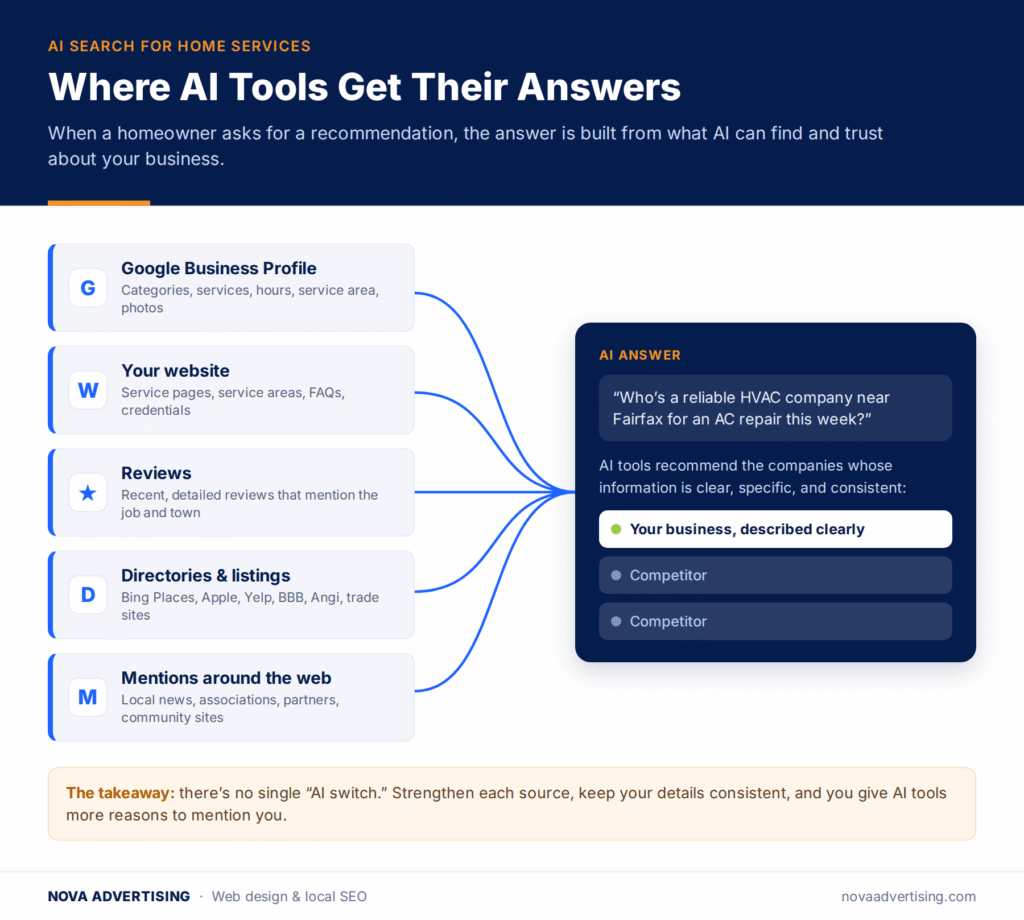
AI tools don’t invent a list of contractors out of thin air. They pull from sources they can find and trust. For a local home service business, that usually means:
1. Your Google Business Profile
For Google’s AI features, your Business Profile is a key source. Google has said there are no special tricks needed to appear in AI Overviews or AI Mode, but it specifically advises businesses to keep their Business Profile information up to date. Your categories, services, hours, service area, photos, and reviews all feed what Google knows about you. Gemini can also draw on Google Maps place data.
2. Your Website
AI tools read websites much like search engines do. Google says a page must be indexed and eligible to show a snippet in regular search to be used as a supporting link in AI Overviews. For ChatGPT, OpenAI says sites need to allow its crawler (OAI-SearchBot) if they want their content included in ChatGPT’s search answers. A clear website that explains what you do, where you do it, and why customers trust you gives these tools something solid to quote.
3. Reviews
Reviews on Google and other platforms give AI tools real customer language to work with. If homeowners consistently mention “showed up on time,” “fixed our furnace same day,” or “clean work on our roof replacement,” that detail helps an AI tool connect your business to those needs.
4. Directories and Third-Party Listings
ChatGPT’s search draws on third-party search providers and data partners, not just Google. That makes consistent listings on sites like Bing Places, Apple Business Connect, Yelp, the BBB, Angi, and industry directories more important than before. If your name, address, phone number, and services don’t match across them, AI tools may get a muddled picture of your business.
5. Mentions Around the Web
Local news coverage, community sponsorships, supplier or manufacturer dealer pages, and trade association listings all help confirm that your business is real, active, and trusted in your area.
What This Means for Plumbers, HVAC Contractors, and Roofers
AI tools aren’t looking for the business with the flashiest ads. They look for the clearest, most consistent, best-supported answer to the homeowner’s question. Here’s how that plays out by trade.
HVAC. A homeowner asks, “Who services heat pumps in Arlington?” If your website has a dedicated heat pump service page that mentions Arlington, your Google profile lists heat pump repair as a service, and your reviews mention heat pumps, you’ve given the AI three matching signals. If your site just says “heating and cooling services,” you’ve given it almost nothing. Our HVAC local SEO guide covers the groundwork in more detail.
Plumbing. Emergency questions are common: “Is there a 24-hour plumber in Reston?” AI tools can only confirm that you offer emergency service if your hours, website, and profile say so clearly and consistently. If your website says “24/7” but your Google profile shows 8 to 5, that mixed message works against you. See our local SEO guide for plumbers for more.
Roofing. Roofing questions are often research-heavy: “How do I know if my roof needs replacing after a storm?” Helpful, plain-English articles that answer these questions give AI tools content to cite, and they position your company as the expert when the homeowner is ready to call.
Landscaping. Seasonal questions like “When should I aerate my lawn in Northern Virginia?” are a natural fit for short, local, helpful content. That kind of answer can earn a mention even before the homeowner is ready to hire.
The Northern Virginia Angle
Northern Virginia is a crowded market for home services. Fairfax, Arlington, Reston, and McLean each have plenty of established contractors competing for the same jobs. That has two consequences for AI search.
First, specific beats general. A homeowner in McLean asking about slate roof repair is more likely to get a precise recommendation than one asking for “a good roofer.” Businesses that clearly describe their specialties and the specific communities they serve give AI tools a reason to pick them for those specific questions.
Second, local proof matters. Mentioning the neighborhoods you work in, the types of homes common in your area (older colonials, townhouse communities, newer builds), and local considerations like HOA approval for exterior work all help show that you know the area. That’s real local expertise, and it reads that way to both homeowners and AI tools.
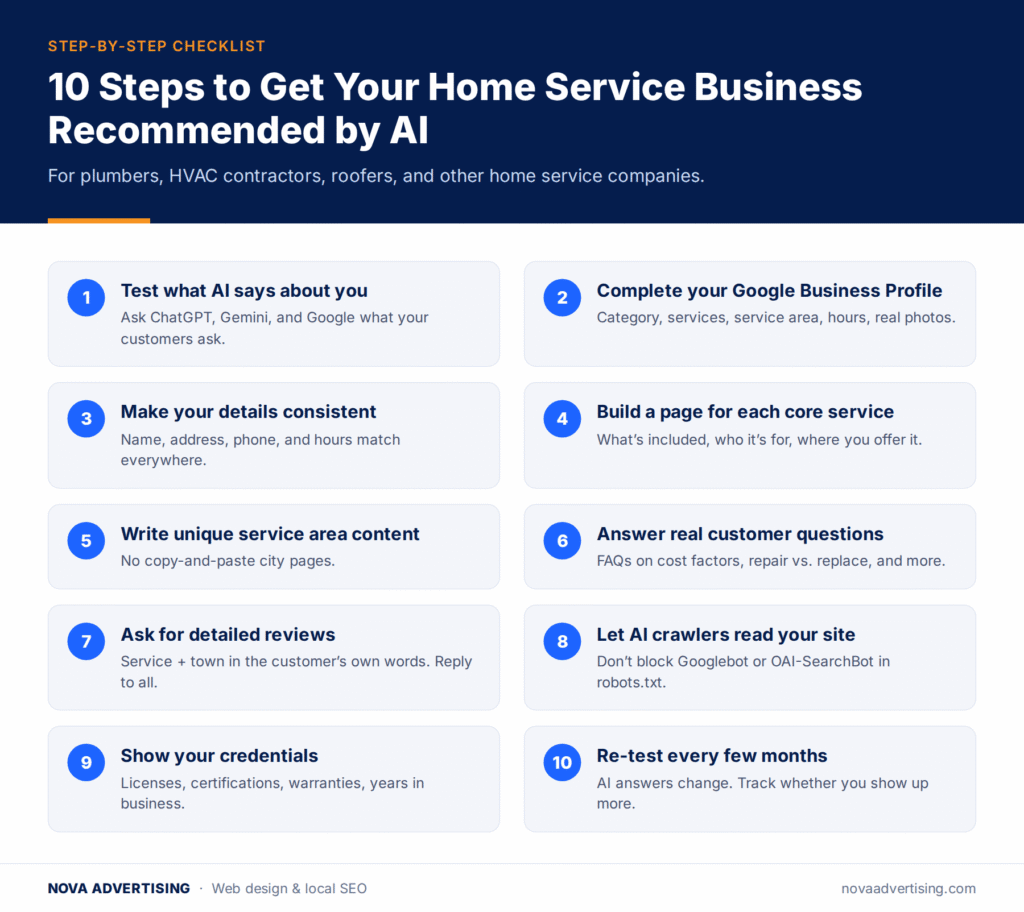
Step-by-Step: How to Get Your Home Service Business Recommended by AI
Here’s a practical list you can work through. Most of these steps also help your traditional Google rankings, so none of the effort is wasted.
- Test what AI says about you today. Ask ChatGPT, Gemini, and Google (check the AI Overview) questions your customers would ask, such as “best [your trade] in [your city]” or “who does [specific service] near [your town].” Write down whether you appear, who does, and what sources get cited.
- Fully complete your Google Business Profile. Choose the most accurate primary category, add every relevant service, set your service area, keep hours current (including emergency hours), and upload real photos of your team and work.
- Make your business details consistent everywhere. Check your name, address, phone number, hours, and website across Google, Bing Places, Apple Business Connect, Yelp, BBB, Angi, and any trade directories. Fix any mismatches.
- Build a page for each core service. One page per main service (for example, AC repair, furnace installation, water heater replacement, roof replacement) that explains what’s included, who it’s for, and where you offer it.
- Add service area content that isn’t copy-and-paste. If you serve Fairfax, Arlington, and Reston, describe the work you do in each area in your own words. Avoid near-duplicate city pages.
- Answer real customer questions on your site. Add FAQs and short articles that answer the questions you hear on the phone every week, like cost factors, repair versus replace, and what to do while waiting for a technician.
- Ask for detailed reviews. Encourage happy customers to mention the service they got and their town. Respond to every review professionally, including the negative ones.
- Make sure AI crawlers can read your site. Check that your robots.txt isn’t blocking Googlebot or OAI-SearchBot, and that your important pages are indexed in Google.
- Show your credentials. List licenses, certifications, manufacturer partnerships, warranties, and years in business clearly on your website.
- Re-test every few months. AI answers change. Repeat step 1 regularly and track whether you’re showing up more often.
Common Mistakes That Keep Contractors Out of AI Answers
- A thin website. A homepage with a phone number and a list of services gives AI tools very little to work with.
- Inconsistent information. Old addresses, outdated phone numbers, or different business names across listings create doubt.
- Ignoring reviews. A profile with few reviews or no owner responses looks less active and less trusted.
- Chasing gimmicks. Google has said there are no special AI files or markup required to appear in AI Overviews. The fundamentals matter more than any trick.
- Blocking crawlers by accident. Some security plugins or hosting settings block bots broadly. If AI crawlers can’t read your site, they can’t cite it.
How Nova Helps Home Service Businesses Show Up in AI Search
At Nova Advertising, we build and optimize websites for home service businesses across Northern Virginia and Dallas. Our approach to AI search builds on the same foundations as strong local SEO: a complete Google Business Profile, clear service pages, consistent listings, and a steady flow of genuine reviews. On top of that, we test how AI tools currently describe your business and close the gaps we find.
Frequently Asked Questions
Do I need a separate “AI SEO” strategy?
Not a completely separate one. Google says there are no additional requirements to appear in AI Overviews or AI Mode beyond regular search eligibility. What changes is the emphasis: clear answers, consistent information across the web, and strong reviews matter even more.
Does ChatGPT use Google reviews?
ChatGPT’s search works with third-party search providers and data partners, so it may not rely on Google data the way Google’s own AI does. That’s why it pays to keep listings and reviews healthy on several platforms, not just Google.
How long does it take to start showing up in AI answers?
There’s no fixed timeline. Fixing listings and your Google Business Profile can have an effect relatively quickly, while content and reviews build over months. Re-testing every few months is the best way to see progress.
Is my website blocking AI tools?
It might be. Some security settings and robots.txt rules block crawlers like OAI-SearchBot. A quick technical check can confirm whether AI tools can read your site.
Should I stop investing in Google Ads or traditional SEO?
No. Traditional search and ads still bring in a large share of home service leads. AI search is an additional channel, and most of the work that helps you there also strengthens your regular rankings.
Ready to See What AI Says About Your Business?
If you run an HVAC, plumbing, roofing, or landscaping company in Northern Virginia or Dallas and want to know whether AI tools are recommending you or your competitors, we can help. Contact Nova Advertising for a free consultation, and we’ll review how your business shows up in AI search and what to fix first.



Get NOVA marketing insights in Google Search
Add NOVA Advertising as a preferred source for practical updates on SEO, AI search, web design, paid advertising, and local marketing.