It’s 8 PM on a Friday night. A potential new patient chips a tooth and immediately searches “emergency dentist near me” on their phone. In that critical moment, your dental practice’s visibility on Google is the only thing that separates you from your competitor down the street. It’s the difference between acquiring a high-value, long-term patient and being completely invisible.
This scenario isn’t just a possibility; it’s the new reality of dental practice marketing. A staggering 87% of consumers use Google to research local businesses, and nearly half of all searches have local intent. For a dental practice in the booming $172.6 billion U.S. dental services market, mastering local Search Engine Optimization (SEO) is no longer an option—it’s the most effective strategy for attracting a consistent flow of qualified, high-value patients.
This guide goes beyond generic advice. We will break down the specific, actionable strategies that top-performing dental practices are using to dominate their local markets in 2026. From optimizing for high-value service keywords to building the trust that turns a searcher into a lifelong patient, you’ll learn how to build a powerful digital presence that drives measurable practice growth.
1. Your Digital Front Door: Mastering Google Business Profile
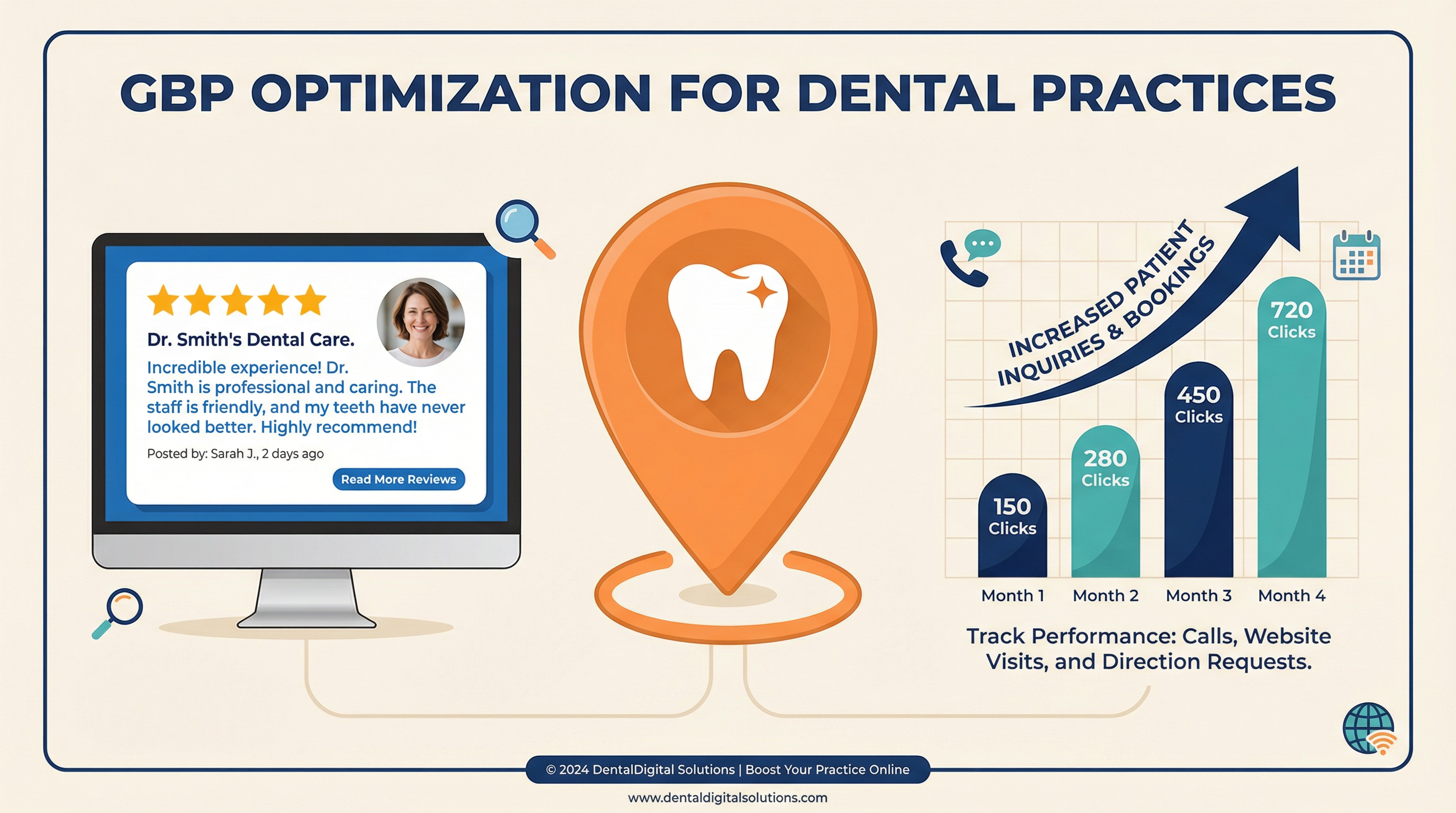
Your Google Business Profile (GBP) is your most valuable digital asset. It’s the first impression for the vast majority of potential patients, heavily influencing your rank in the Google Maps “Local Pack.” With 87% of consumers using Google to find local businesses, an optimized GBP is non-negotiable.
How to Optimize Your GBP for a Dental Practice
Strategic Category & Service Selection
Your primary category must be “Dentist.” However, secondary categories are where you capture specific patient needs. Add categories like “Cosmetic Dentist,” “Pediatric Dentist,” and “Emergency Dental Service.” Under the “Services” section, list every high-value procedure you offer, such as “Invisalign,” “Dental Implants,” “Teeth Whitening,” “Root Canal Therapy,” and “Porcelain Veneers.” This tells Google to show your practice for lucrative, specific searches.
Showcase Your Practice with Photos
Patients are choosing a healthcare provider; they want to see your practice before they visit. Upload high-quality photos of your modern office interior, your friendly team, advanced technology (like CEREC machines or 3D scanners), and happy patient smiles (with signed consent). Profiles with 100+ photos see significantly more engagement.
Use Google Posts to Drive Action
Your practice isn’t static, so your GBP shouldn’t be. Use Google Posts to highlight current offers and services:
- Offers: “New Patient Special: $99 Exam, X-Rays & Cleaning!”
- Events: “Join Our Invisalign Open House This Saturday!”
- Services: “Considering Dental Implants? Schedule a Free Consultation.”
- Education: “Learn the Benefits of Regular Dental Check-ups.”
2. Beyond “Dentist Near Me”: Advanced Keyword Strategy
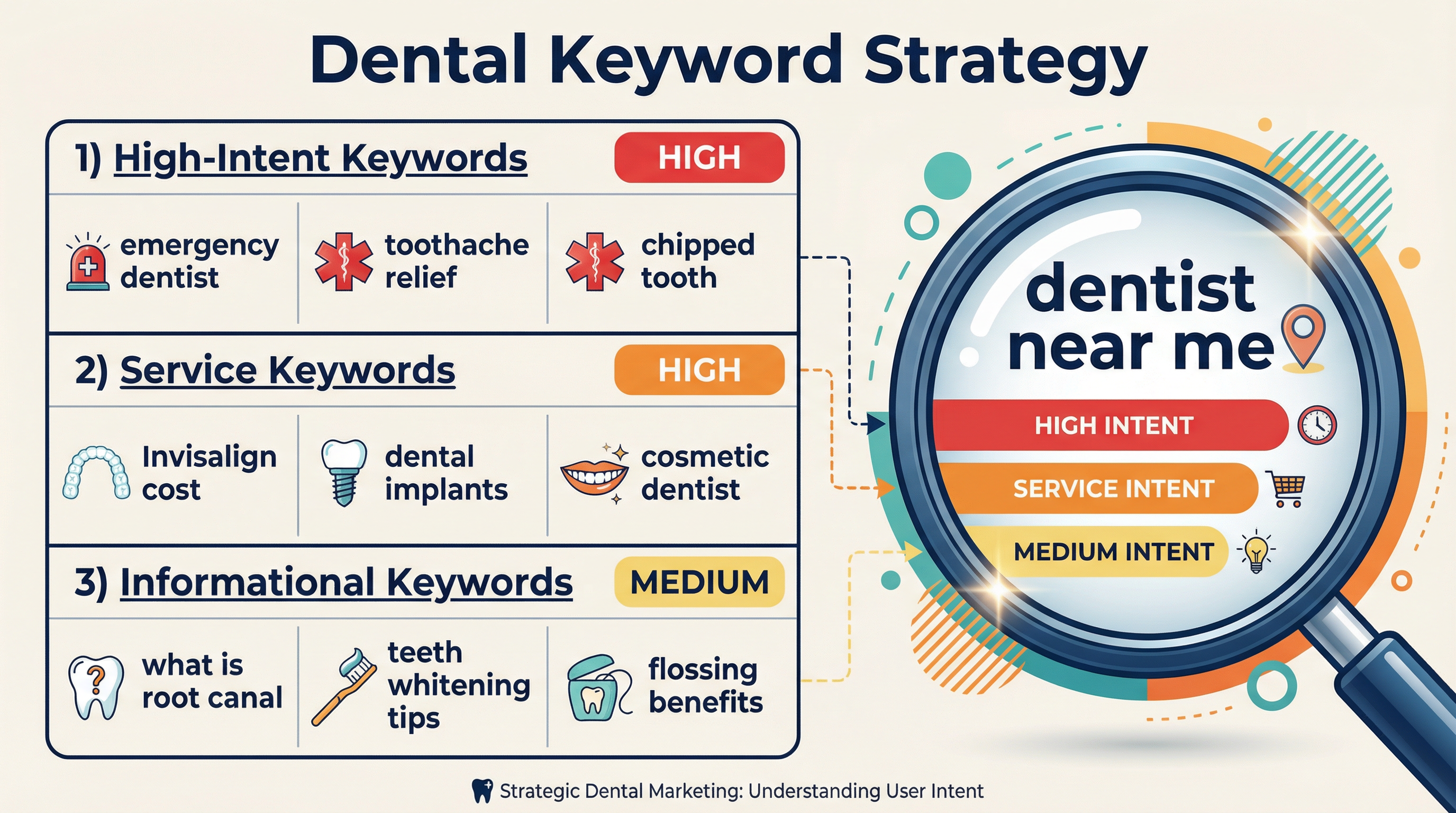
Effective dental SEO requires a deep understanding of patient intent. You must target keywords across the entire patient journey, from initial pain to cosmetic consideration.
The Three Tiers of Dental Keywords
| Keyword Category | Patient Mindset & Examples | Search Intent |
|---|---|---|
| High-Intent / Problem-Based | “chipped tooth repair,” “toothache relief,” “emergency dentist near me” |
Highest |
| Solution-Oriented / Service | “Invisalign cost,” “best cosmetic dentist in [city],” “dental implants financing” | High |
| Research / Informational | “what is a root canal,” “how to whiten teeth at home,” “signs you need a dental crown” | Medium |
Use tools like Ahrefs and SEMrush to build your keyword list, but also listen to your patients. What specific terms do they use on the phone? Integrate these keywords into dedicated service pages. A page for “Dental Implants” should also address terms like “cost of dental implants” and “single tooth replacement options.”
3. From Suburb to City: Ranking with Hyper-Local Pages
Simply listing the towns you serve on your website is not enough. To rank in neighboring communities, you need dedicated, hyper-local landing pages. Each page acts as a digital billboard in that specific town, signaling your relevance to Google.
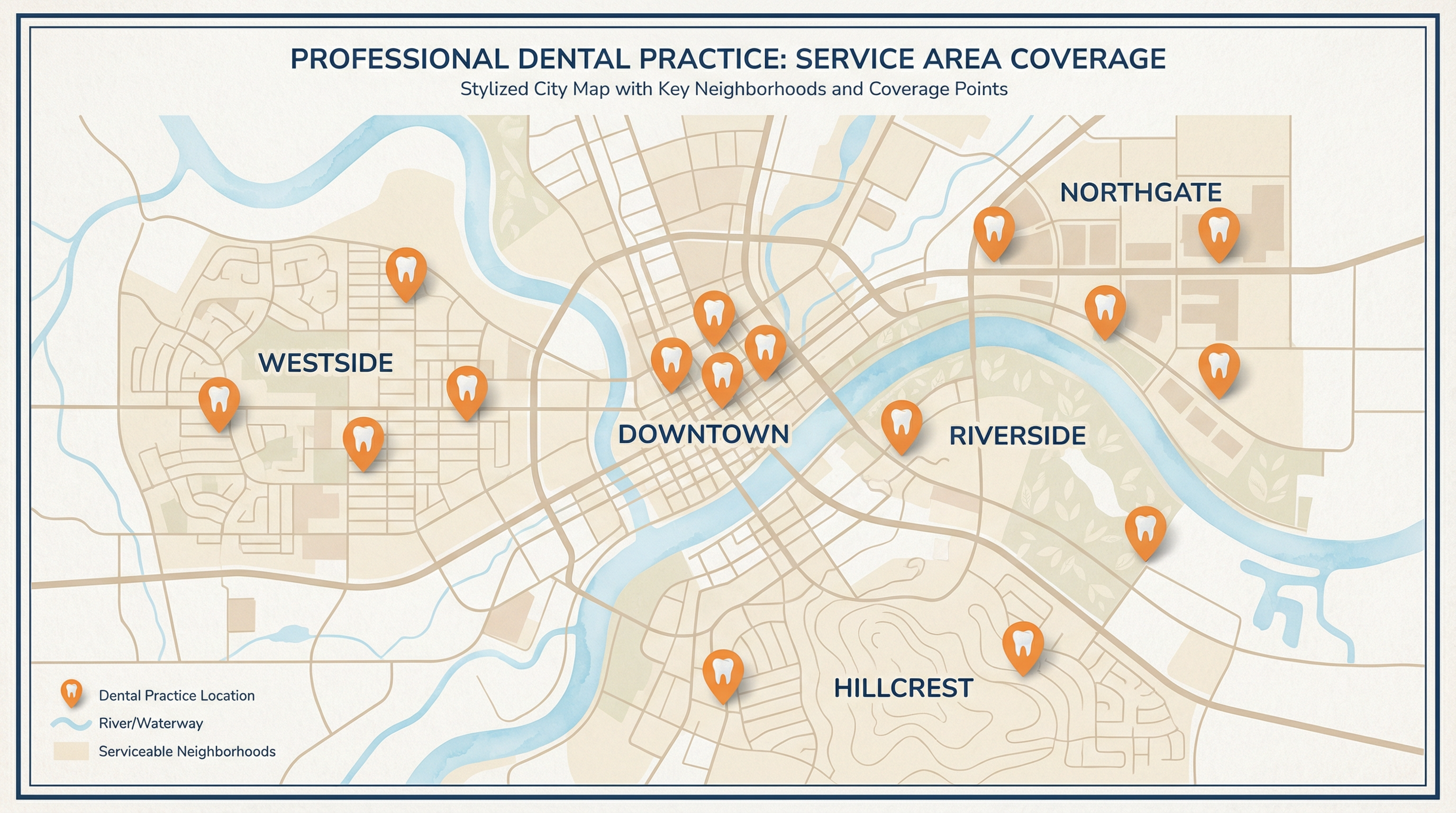
Blueprint for a High-Ranking Dental Location Page
Unique, Localized Content
Do not copy and paste content. For each page, write a unique introduction that mentions the specific city. Reference local landmarks, neighborhoods, or community events. For example: “Proudly serving the families of the [Neighborhood Name] community with compassionate dental care.”
Include Local Proof
Feature video testimonials from patients in that specific city. A review that says, “Dr. Smith is the best dentist in [City Name]!” is incredibly powerful. Embed a Google Map showing your office’s proximity to the target city.
Hyper-Targeted On-Page SEO
Optimize the page’s title tag and H1 heading: “Your Trusted Family Dentist in [City], TX” or “Top-Rated Cosmetic Dentistry in [City], VA.” Mention the city and nearby neighborhoods naturally throughout the page content.
4. The Digital Handshake: Building Patient Trust & Reputation
In healthcare, trust is the ultimate currency. An overwhelming 98% of consumers read online reviews for local businesses, and they trust Google reviews more than any other platform. Your online reputation is your most powerful marketing asset.

A Proactive Review Generation System
Don’t wait for reviews; actively cultivate them. Implement an automated system (via text or email) that sends a review request within a few hours of a completed appointment. Make it easy with a direct link to your Google review page.
Respond to Every Review (HIPAA-Compliantly)
Responding to reviews shows you care. For positive reviews, thank the patient personally. For negative reviews, provide a HIPAA-compliant response acknowledging their feedback and inviting them to discuss the matter offline. A professional response to criticism can often build more trust than a dozen 5-star reviews.
5. The Mobile Patient: Optimizing Your Site for Appointments
With 63% of all Google search traffic coming from mobile devices, your website must be designed for a patient on the go. An emergency search for a dentist is almost always happening on a smartphone.
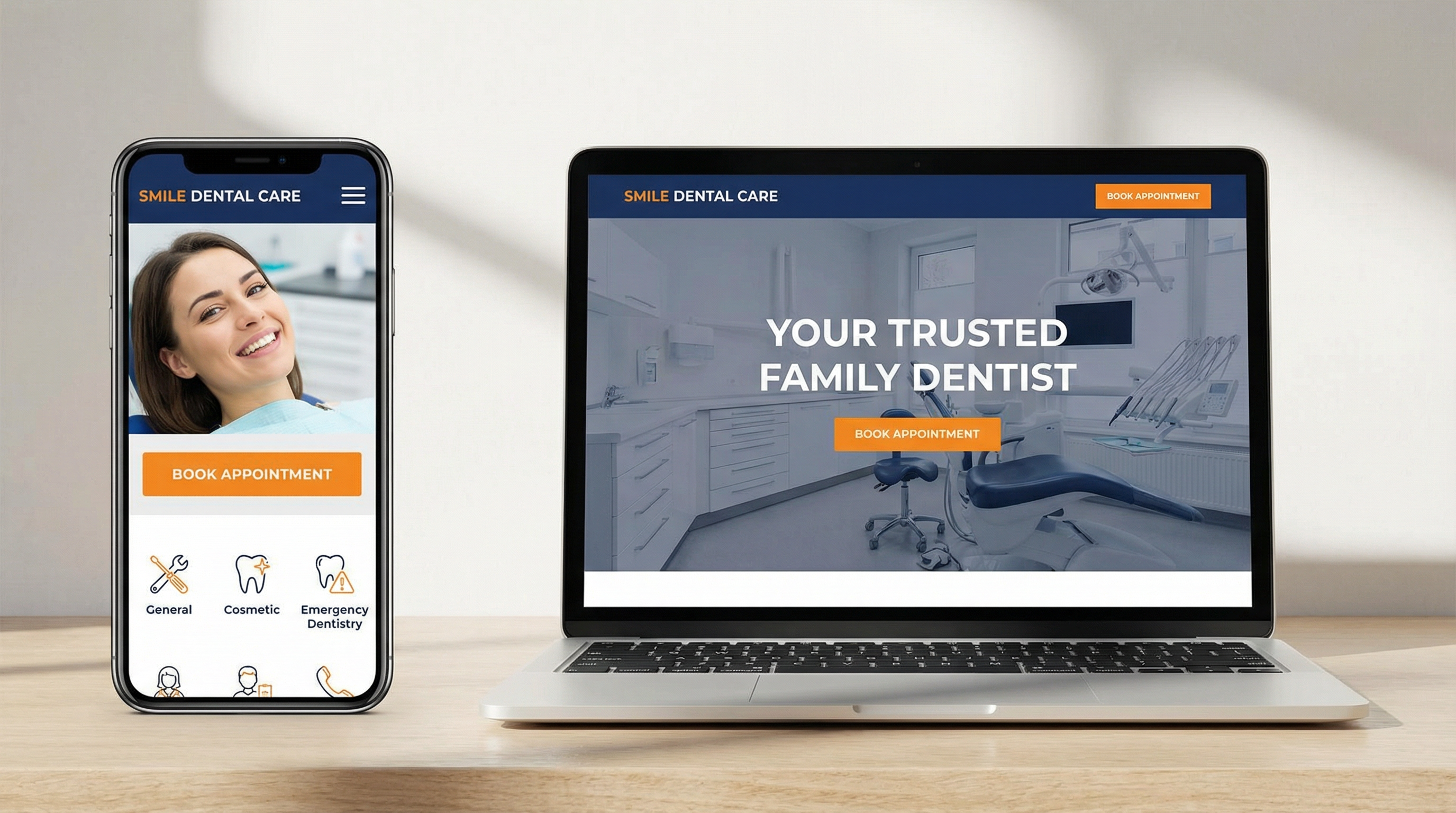
The Dental Mobile Optimization Checklist
Sub-3-Second Load Speed
Every second of delay is a potential lost patient. Use Google’s PageSpeed Insights to diagnose and fix issues. A slow website is the digital equivalent of putting a patient on hold for ten minutes.
Click-to-Call & Online Booking
Your phone number must be a clickable button in the header and a “sticky” footer. More importantly, integrate an online scheduling tool. Allowing patients to book an appointment directly from your site at any time of day is a massive competitive advantage.
Build Trust on the Page
Your service pages must immediately build confidence. Prominently display:
- Trust Badges: ADA Member, Invisalign Gold Provider, Top Dentist Awards.
- Insurance & Financing: Show logos of accepted insurance plans and financing partners like CareCredit.
- Urgency Signals: “Same-Day Emergency Appointments Available.”
- Social Proof: Display your Google star rating and number of reviews.
Frequently Asked Questions for Dental Practice Owners
Ready to Fill Your Schedule with High-Value Patients?
Local SEO is the most powerful and cost-effective way to grow your dental practice. It’s a direct line to patients actively seeking the high-value services you provide. But it requires deep industry knowledge, technical precision, and a commitment to building patient trust at every digital touchpoint.
At NOVA Advertising, we specialize in marketing for dental and home service companies. We understand the patient journey, the competitive landscape, and how to build a digital presence that translates into booked appointments.
Our Dental Marketing Services Include:
- Dominant Local SEO: We get you ranked in the Google Maps pack for the keywords that matter.
- High-Conversion Websites: We build sites designed to turn visitors into new patients.
- Targeted Google Ads: We generate immediate leads for your most profitable procedures.
- 5-Star Reputation Management: We build the trust that creates lifelong patients.
Stop Competing for Patients. Start Owning Your Market.
References
- My Social Practice. (2024). 16 Google Search Statistics for Dentists to Know. https://mysocialpractice.com/2024/09/google-search-statistics-for-dentists/
- Towards Healthcare. (2025). U.S. Dental Services Market to Reach USD 254.7 Bn by 2034. https://www.towardshealthcare.com/insights/us-dental-services-market-sizing
- Marketly Digital. (2025). 5 Metrics That Predict Dental Practice Growth. https://www.marketlydigital.com/blog/predict-dental-practice-growth/