

Washington D.C. is more than just the nation’s capital; it’s a thriving hub of innovation, culture, and commerce. For small businesses, the district offers a unique and dynamic market, but it also comes with intense competition. To not only survive but thrive in 2025, D.C. small businesses must look beyond traditional marketing and embrace a new era of digital engagement. The coming year will be defined by the intelligent use of artificial intelligence (AI), a renewed focus on data privacy, and the power of authentic customer connections. This guide will explore the key digital marketing trends that will empower your D.C. business to stay ahead of the curve and build a resilient, future-proof brand.
1. Hyper-Personalization Through AI: The New Standard in Customer Engagement
In a city as diverse and dynamic as Washington D.C., a one-size-fits-all approach to marketing is no longer effective. Customers today expect personalized experiences that cater to their unique needs and preferences. This is where AI-driven hyper-personalization comes in, and it’s poised to become the new standard in customer engagement for 2025. By leveraging the power of artificial intelligence, businesses can now move beyond broad market segmentation and engage with customers on an individual level, delivering tailored messaging, offers, and experiences in real time.

Hyper-personalization utilizes AI and machine learning algorithms to analyze vast amounts of customer data, including browsing history, purchase behavior, and demographic information. This allows businesses to gain a deep understanding of their customers and anticipate their needs before they even arise. For instance, an e-commerce store in Georgetown could use AI to recommend products to a customer based on their past purchases and browsing activity, while a restaurant in Dupont Circle could send personalized offers to regulars based on their favorite dishes and dining times. According to a recent study by Nielsen, 59% of global marketers believe that AI for campaign personalization and optimization will be the most impactful industry trend by 2025 [1].
For Washington D.C. small businesses, hyper-personalization offers a powerful way to cut through the noise and build meaningful relationships with customers. In a competitive market where consumers are bombarded with marketing messages, a personalized touch can make all the difference. By delivering relevant and timely content, businesses can not only increase engagement and conversion rates but also foster a sense of loyalty and trust that is essential for long-term success.
2. Embrace First-Party and Zero-Party Data: Build Trust and Deeper Insights
The digital marketing landscape is undergoing a seismic shift. For years, businesses have relied on third-party cookies to track user behavior across the web, but growing privacy concerns have led to their decline. In 2025, the ability to collect and leverage first-party and zero-party data will be a key differentiator for small businesses in Washington D.C. This shift towards a privacy-first approach is not just about compliance; it’s about building trust and gaining deeper, more authentic insights into your customers.

First-party data is information that a business collects directly from its customers with their consent. This includes data from website interactions, purchase history, email engagement, and social media activity. Zero-party data, on the other hand, is information that customers willingly and proactively share with a business, such as through polls, quizzes, or preference centers. By focusing on these data sources, businesses can gain a much richer understanding of their customers’ needs and preferences while respecting their privacy. A study from Doba has highlighted the significant shift from third-party to first-party data strategies as a key trend [2].
For D.C. small businesses, building a first-party data strategy is essential for creating the personalized experiences that customers now expect. You can start by implementing a clear and transparent privacy policy on your website, and by using tools like email newsletters, customer surveys, and interactive social media content to encourage customers to share their information. By being upfront about how you collect and use data, you can build a foundation of trust that will not only enhance your marketing efforts but also strengthen your brand’s reputation in a city where trust and transparency are highly valued.
3. AI as a Co-Creator: Supercharge Your Content and Storytelling
The rise of generative AI has created a paradigm shift in content creation. For small businesses in Washington D.C., AI is no longer just a tool for automation; it’s a creative partner that can help you supercharge your content and storytelling. By embracing AI as a co-creator, you can produce high-quality, engaging content at a fraction of the cost and time it would take with traditional methods. This allows you to compete with larger organizations and establish a strong brand voice in a crowded market.
AI-powered tools can assist with every stage of the content creation process, from brainstorming ideas and writing blog posts to creating social media captions and generating video ads. Frameworks like HubSpot’s “The Loop” (Express → Tailor → Amplify → Evolve) emphasize how AI can help marketers craft tailored, multi-channel campaigns that resonate with their target audience. The Interactive Advertising Bureau (IAB) projects that 40% of video ads will be produced with the help of generative AI by 2026 [3], highlighting the growing importance of this technology.
For D.C. small businesses, this means you can create a consistent stream of high-quality content without needing a large in-house marketing team. Whether you’re a boutique on M Street looking to create engaging social media content or a B2B consultant in the downtown area wanting to produce insightful blog posts, AI can help you achieve your content marketing goals. The key is to use AI as a tool to augment your creativity and expertise, not replace it. By combining the power of AI with your unique brand voice and industry knowledge, you can create content that is not only engaging but also authentic and valuable to your audience.
4. Prioritize Cybersecurity and Tech Resilience: Protect Your Brand and Customers
In today’s digital world, a strong cybersecurity posture is not just a technical necessity; it’s a fundamental aspect of brand trust and customer loyalty. For small businesses in Washington D.C., where reputation is everything, a data breach can be devastating. As more businesses embrace digital technologies, the risk of cyberattacks is also on the rise. That’s why prioritizing cybersecurity and building a resilient tech stack is crucial for staying competitive and protecting your brand in 2025.

A recent survey by Mastercard revealed that 46% of small businesses have experienced a cyberattack, and for many, the consequences were severe [4]. The financial costs of a breach can be crippling, but the damage to your brand’s reputation can be even more lasting. In a city like D.C., where customers value trust and security, a single cybersecurity incident can erode years of hard-earned credibility. This is why it’s essential to invest in a robust cybersecurity strategy that includes everything from employee training and data encryption to regular security audits and a resilient tech stack.
Building a resilient tech stack means choosing reliable and secure tools for your website hosting, customer relationship management (CRM), and other critical business functions. It also means having a plan in place to ensure business continuity in the event of a cyberattack or other technical disruption. By taking a proactive approach to cybersecurity, you can not only protect your business from financial and reputational damage but also demonstrate to your customers that you are committed to safeguarding their data. This commitment to security will be a key differentiator for D.C. small businesses in 2025 and beyond.
5. Short-Form & Immersive Content: Capture Attention in a Fast-Paced World
In a city that never sleeps, capturing the attention of your audience requires content that is not only engaging but also easily digestible. This is where short-form video and immersive content come in. In 2025, platforms like TikTok, Instagram Reels, and YouTube Shorts will continue to dominate the social media landscape, offering a powerful way for Washington D.C. small businesses to connect with a digitally-savvy and mobile-first audience. By embracing these formats, you can create a dynamic and interactive brand experience that stands out from the competition.
Short-form videos are perfect for showcasing your brand’s personality, highlighting your products or services, and sharing behind-the-scenes glimpses of your business. They are also highly shareable, which can help you reach a wider audience and increase brand awareness. In addition to short-form video, immersive formats like augmented reality (AR) filters, virtual reality (VR) experiences, and interactive polls and quizzes can help you create a more engaging and memorable brand experience. A recent report from LocaliQ found that 76% of small businesses have seen improved performance through social media platforms [5], and these new formats are a key driver of that success.
For D.C. small businesses, this means thinking beyond static content and creating a more dynamic and interactive online presence. Whether you’re a restaurant in Adams Morgan using AR to create a virtual menu or a retail shop in Georgetown using Instagram Reels to showcase your latest collection, these formats can help you connect with your audience in a more meaningful way. By embracing the power of short-form and immersive content, you can create a brand experience that is not only engaging but also highly effective at driving conversions and building a loyal following.
6. Social Commerce & Local Community Connection: Drive Sales and Build Loyalty
Social media is no longer just a platform for brand awareness; it’s a powerful engine for driving sales and building a loyal community around your brand. In 2025, social commerce will continue to grow, offering a seamless way for Washington D.C. small businesses to sell their products and services directly through social media platforms. By combining the power of social media with a deep understanding of the local community, you can create a marketing strategy that is not only effective but also authentic and resonant.
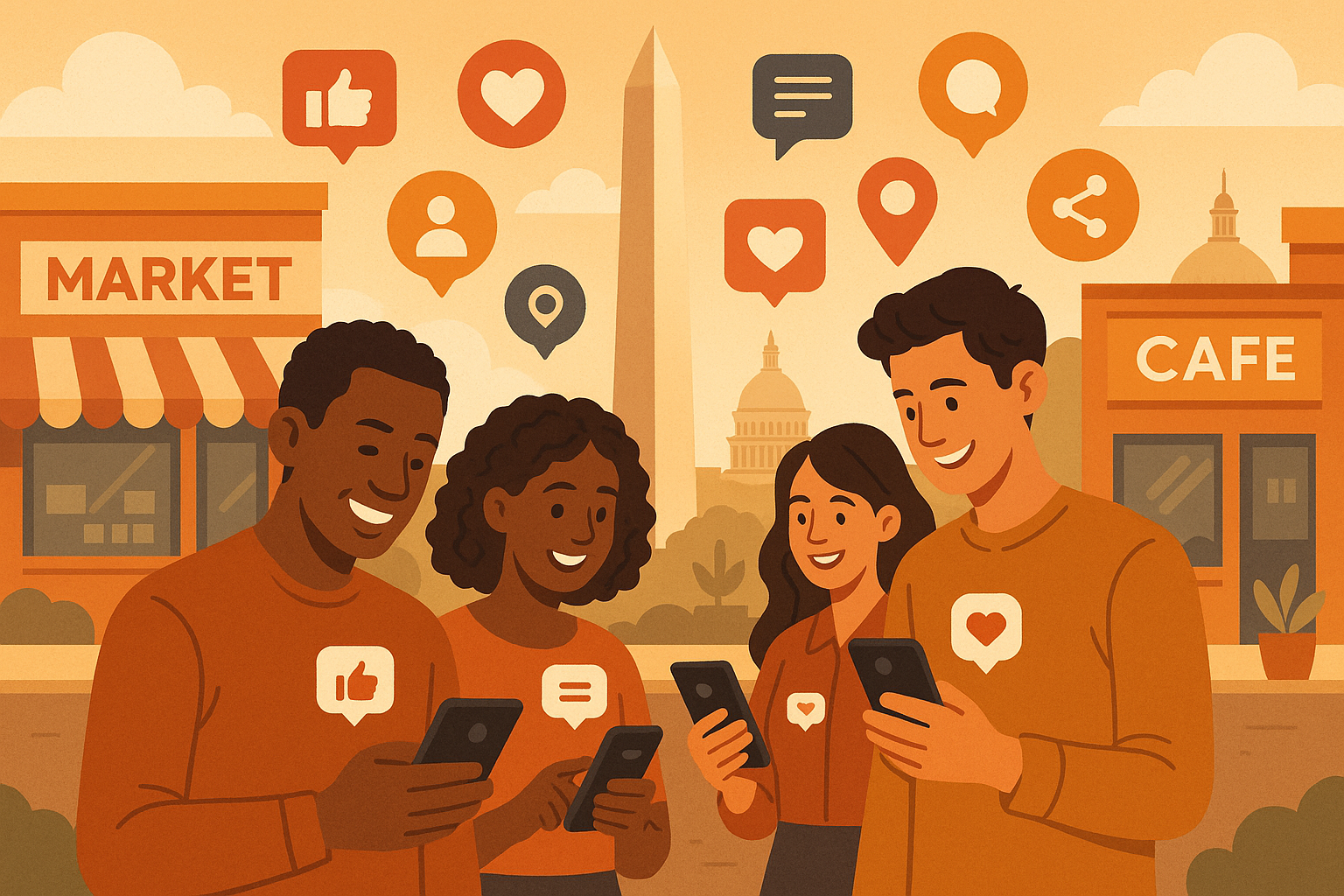
Creating campaigns that celebrate the unique culture and identity of Washington D.C. is a powerful way to connect with your audience on a deeper level. Whether you’re a coffee shop in Capitol Hill hosting a local artist showcase or a bookstore in Eastern Market featuring D.C.-based authors, these hyper-local initiatives can help you build a strong sense of community around your brand. By telling authentic stories that resonate with the values and interests of your target audience, you can create a brand that people not only buy from but also believe in.
For D.C. small businesses, this means tapping into the strong sense of community that defines the district. By partnering with other local businesses, sponsoring community events, and creating content that celebrates the unique character of your neighborhood, you can build a brand that is not only successful but also a valued part of the local community. In a city where relationships matter, this focus on local connection will be a key driver of success in 2025 and beyond.
7. Voice & Visual Search Optimization: Be Found in New Ways
The way people search for information is evolving. While traditional text-based search is still dominant, voice search and visual search are rapidly gaining popularity. In 2025, optimizing your content for these new search modalities will be crucial for Washington D.C. small businesses to stay visible and attract new customers. By understanding how people use voice and visual search, you can create a content strategy that meets them where they are and makes it easy for them to find your business.
Voice search, powered by digital assistants like Siri, Alexa, and Google Assistant, is becoming increasingly popular for local searches. People are now using voice commands to find everything from the nearest coffee shop to the best dry cleaner in their neighborhood. To optimize for voice search, you need to focus on conversational keywords and long-tail phrases that mimic natural language. For example, instead of optimizing for the keyword “D.C. restaurants,” you might optimize for the phrase “What are the best restaurants near me in Washington D.C.?”
Visual search, on the other hand, allows users to search for information using images instead of text. With tools like Google Lens, people can now take a picture of a product, landmark, or even a plant and get instant information about it. To optimize for visual search, you need to use high-quality images with descriptive alt text and file names. You should also consider creating a visual sitemap for your website to make it easier for search engines to crawl and index your images. By embracing both voice and visual search, you can ensure that your D.C. small business is visible and accessible to customers, no matter how they choose to search.
8. Ethical AI & Trust: The Foundation of a Sustainable Strategy
As artificial intelligence becomes more integrated into our daily lives, the importance of ethical AI practices cannot be overstated. For small businesses in Washington D.C., a city built on trust and relationships, building an AI-powered marketing strategy that is both effective and ethical is non-negotiable. In 2025, transparency, governance, and human oversight will be the cornerstones of a sustainable and successful AI strategy.
While AI offers immense potential for businesses, it also comes with a responsibility to use it ethically and transparently. This means being upfront with customers about how you are using their data, ensuring that your AI algorithms are fair and unbiased, and having a human in the loop to oversee and guide your AI-powered initiatives. By communicating your commitment to ethical AI, you can build a foundation of trust that will not only enhance your brand’s reputation but also foster a sense of loyalty and confidence among your customers.
For D.C. small businesses, this means taking a thoughtful and deliberate approach to AI adoption. Instead of blindly implementing the latest AI tools, take the time to understand how they work and how they will impact your customers. Develop a clear set of ethical guidelines for your AI initiatives, and make sure that your entire team is trained on these principles. By prioritizing ethical AI and trust, you can build a marketing strategy that is not only powerful but also sustainable and aligned with the values of your community.
Conclusion: Your Partner in Digital Growth
The digital marketing landscape is constantly evolving, but one thing remains constant: the importance of building authentic relationships with your customers. For Washington D.C. small businesses, the key to success in 2025 will be to embrace the latest digital marketing trends while staying true to your brand’s values and the unique character of the district. By leveraging the power of AI, embracing a privacy-first approach to data, and creating engaging and authentic content, you can build a brand that not only survives but thrives in the competitive D.C. market.
At Nova Advertising, we understand the unique challenges and opportunities of the Washington D.C. market. We are committed to helping small businesses like yours navigate the ever-changing digital landscape and achieve their growth goals. Whether you need help with AI-powered personalization, a robust cybersecurity strategy, or a compelling social media campaign, our team of experts is here to help. Contact us today for a consultation and let us be your partner in digital growth.
References
[1] Nielsen. (2025). How AI is redefining marketing, today and tomorrow.
[2] Doba. (n.d.). Trust in the age of artificial intelligence: a framework for privacy protection in personalised marketing.
[3] TV Technology. (2024). Nearly 90 Percent of Advertisers Will Use Gen AI to Build Video Ads, According to IAB.
[4] Mastercard. (2025). Small business cybersecurity: Survey shows reason for worry.
[5] LocaliQ. (2025). The Big Small Business Marketing Trends Report for 2025.


Get NOVA marketing insights in Google Search
Add NOVA Advertising as a preferred source for practical updates on SEO, AI search, web design, paid advertising, and local marketing.