
Prospective patients used to find a new dentist by searching “dentist near me,” skimming the map, and checking a few websites. Many still do. But more of them now ask an AI tool a fuller question, such as “Who’s a gentle dentist in Arlington who takes my insurance and is good with anxious patients?” Then they go with the answer they’re given.
For practice owners, that raises a new question: when a patient asks AI for a dentist, is your practice part of the answer?
This guide builds on our Local SEO for Dentists guide. The fundamentals in that guide still apply, including a strong Google Business Profile, local pages, and reviews. Here we focus on what AI search adds: how ChatGPT, Gemini, and Google’s AI Overviews decide what to say about dental practices, and the specific steps that make your practice easier to recommend.
How Patients Use AI to Choose a Dentist
Patient questions to AI tools tend to be longer and more personal than traditional searches. For example:
- “Which dentists in Fairfax offer same-day crowns?”
- “Is Invisalign or traditional braces better for an adult? Who does Invisalign in Reston?”
- “I have a cracked tooth and it’s Saturday. Is there an emergency dentist near McLean?”
- “Find a family dentist near me that accepts [insurance plan] and sees kids.”
Each question combines research with a request for a recommendation, and more patients are asking this way. In a 2026 survey by rater8, 47% of patients said they use AI chatbots to find healthcare providers, up from 31% at the end of 2025.
The tools patients are most likely to use:
- Google AI Overviews and AI Mode. AI summaries at the top of Google results, plus Google’s more conversational AI Mode.
- ChatGPT. ChatGPT can search the web, may use a user’s approximate location to find nearby businesses, and can show a map on mobile, according to OpenAI.
- Gemini. Google’s assistant, which can draw on Google Maps place data.
What AI Tools Look At When Recommending a Practice
AI tools build their answers from information they can find and trust. For a dental practice, the key sources are your Google Business Profile, your website, your reviews, and how consistently your practice is described across the web.
Google has said there are no special requirements or markup needed to appear in AI Overviews or AI Mode. Pages simply need to be indexed and eligible to show in regular search, and Google advises keeping your Business Profile up to date. On the ChatGPT side, OpenAI says sites need to allow its crawler, OAI-SearchBot, for their content to be included in ChatGPT’s search answers.
In other words, there’s no secret “AI switch.” The practices that get recommended are the ones that give AI tools clear, specific, consistent answers to patients’ questions.
1. Build Service Pages That Answer Patient Questions
A single “Services” page with a bulleted list of treatments gives AI tools almost nothing to work with. Patients ask detailed questions, and AI tools look for pages that answer them.
For each core treatment (implants, Invisalign, crowns, veneers, emergency care, pediatric dentistry, sedation, cleanings), create a dedicated page that covers:
- What the treatment is, in plain English
- Who it’s right for (and who might need a different option)
- What to expect at each visit, and roughly how many visits it takes
- Recovery and aftercare basics
- Cost factors, meaning what affects the price, whether insurance typically helps, and what financing you offer (you don’t need to list exact prices)
- Common questions patients ask your front desk
Example: An emergency dentistry page that clearly says whether you see same-day emergencies, lists your after-hours process, and explains what to do for a knocked-out tooth before arriving is much more likely to be cited when someone asks “emergency dentist near me open today.”
2. Showcase Your Dentists’ Bios and Credentials
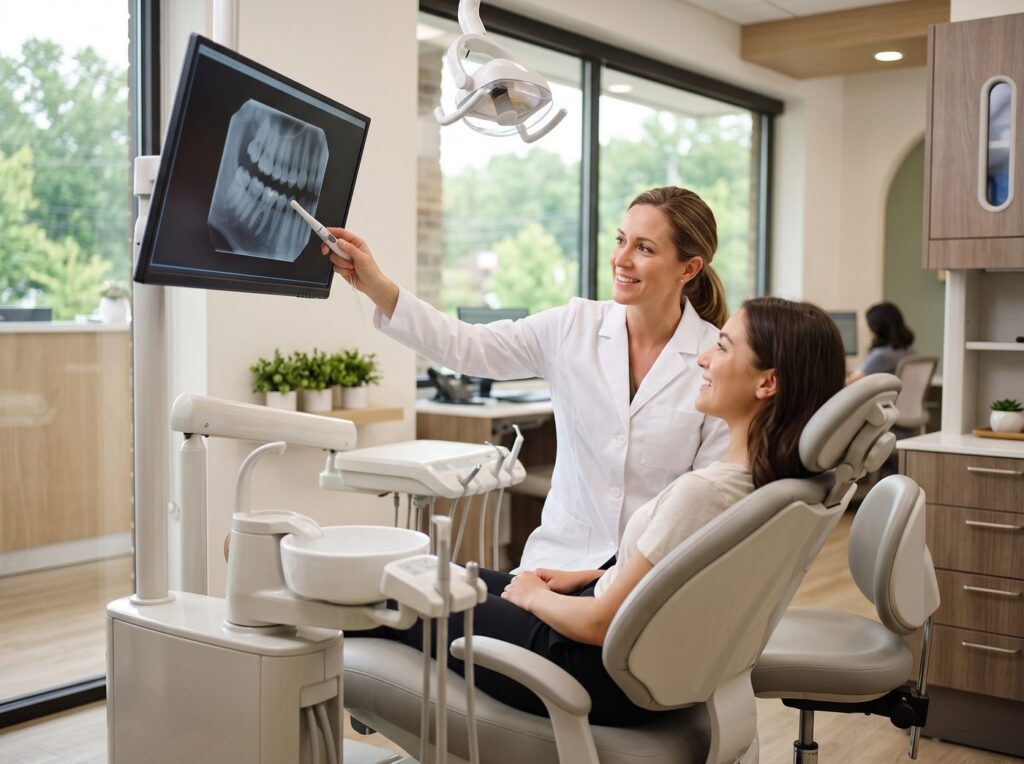
Patients care about who will be treating them, and AI tools look for signs of expertise and trust. Every dentist and specialist at your practice should have a bio page that includes:
- Full name and credentials (DDS or DMD)
- Dental school and any residencies or specialty training
- Professional memberships (for example, state and national dental associations)
- Continuing education and advanced training (implants, sedation, clear aligners)
- Languages spoken
- A short personal note, such as why they chose dentistry or what they enjoy outside the office
Make sure the same names and credentials appear on your Google Business Profile, your website, and any directory listings like Healthgrades or Zocdoc. Consistency helps AI tools connect the dots.
3. Encourage Reviews That Describe the Experience
Reviews are one of the richest sources AI tools have for describing a practice. A two-word review helps a little. A review that names the treatment the patient had, the dentist they saw, and what stood out (such as a comfortable implant process or a team that explained every step) helps a lot more, because it connects your practice to a specific treatment and a specific quality.
How to encourage more useful reviews:
- Ask after positive visits, while the experience is fresh
- Make it easy with a direct review link by text or email
- Invite patients to mention what they came in for, if they’re comfortable doing so
- Respond to every review promptly and professionally
A Note on HIPAA and Review Responses
Be careful when you respond to reviews. Under HIPAA, confirming that someone is your patient or discussing their treatment in a public reply can create privacy problems, even if the patient shared those details first. Keep responses general, such as “Thank you for your kind words. We’re glad you had a great experience with our team.” For negative reviews, invite the reviewer to contact the office directly. The same caution applies to AI tools. Don’t paste patient names, records, or other protected information into ChatGPT or similar tools unless your practice has confirmed that the tool and your agreements meet your HIPAA obligations. This isn’t legal advice, so check with your compliance advisor or attorney about your practice’s specific policies.
4. Make Insurance and Payment Information Easy to Find
“Does this dentist take my insurance?” is one of the most common questions patients ask, and it’s one AI tools try to answer directly. If that information is buried in a PDF or missing entirely, the AI may skip your practice or give a vague answer.
- Create a clear Insurance & Financing page that lists the plans you’re in network with, or explains how you work with out-of-network plans
- Mention payment options, financing partners, and any in-house membership plan
- Keep your insurance list current and matching across your website and Google Business Profile
- Answer common insurance questions in an FAQ section
5. Keep Your Google Business Profile Complete and Accurate
This was a cornerstone of our local SEO for dentists guide, and it matters even more for AI search. Google specifically advises businesses to keep their Business Profile information current for its AI features. Check that your profile includes:
- The most accurate primary category (for example, “Dentist,” “Pediatric dentist,” or “Cosmetic dentist”)
- Every service you offer
- Accurate hours, including holiday and emergency hours
- Accessibility details, languages, and amenities
- Recent photos of your office, team, and technology
- Regular Google Posts about services, technology, and community involvement
6. Test What AI Says About Your Practice
Accuracy matters here. In the same rater8 survey, two-thirds of patients who had used AI to research a provider said they had come across incorrect provider information. You can’t improve what you don’t measure, so every few months, run a quick AI visibility check:
- Ask ChatGPT questions a new patient would ask, like “best dentist in [your city] for [treatment]” or “dentist near [neighborhood] that accepts [insurance].”
- Ask Gemini the same questions.
- Search Google for the same terms and read the AI Overview if one appears.
- Write down whether your practice appears, which competitors appear, and which sources are cited.
- Check accuracy. Are your hours, services, insurance plans, and dentists described correctly? Note anything outdated or wrong.
- Fix the source. If an AI tool gets something wrong, find where that information likely came from, such as an old directory listing or an outdated page, and correct it.
- Re-test after your updates to see what changed.
The Northern Virginia Angle
Dental practices in Fairfax, Arlington, Reston, and McLean compete in a busy, well-informed market. Many patients are comparing several practices before they book, and they often search around specific needs, like weekend hours for commuters, pediatric care for young families, or cosmetic work.
That’s an opportunity. Practices that clearly describe their specialties, the communities they serve, and practical details (parking, Metro access, evening or weekend hours, languages spoken) give AI tools the specifics they need to recommend them for those precise questions.
Quick Checklist: AI Search Readiness for Dental Practices
- Dedicated page for each core treatment, written for patients
- Bio pages for every dentist, with credentials and training
- Clear insurance and financing page
- Complete, current Google Business Profile
- Consistent practice details across directories (Healthgrades, Zocdoc, Yelp, Bing Places, Apple Business Connect)
- Steady stream of detailed, genuine reviews, with HIPAA-conscious responses
- Website readable by Google and OAI-SearchBot (not blocked in robots.txt)
- AI visibility check completed and scheduled to repeat
If your site is missing some of the basics, our guide to must-have features for your dental website is a good place to start.
Frequently Asked Questions
Is AI SEO different from regular dental SEO?
It builds on the same foundations. Google says there are no additional requirements to appear in AI Overviews beyond regular search eligibility. The difference is emphasis: detailed answers to patient questions, clear credentials, and consistent information across the web carry even more weight.
Can I pay to be recommended by ChatGPT or Gemini?
Not in the answers themselves. ChatGPT now shows ads to some users, but OpenAI says ads are labeled as sponsored, kept separate from the response, and don’t influence ChatGPT’s answers. The recommendations themselves are based on the information these tools can find about your practice, so improving that information is the most reliable path.
What if an AI tool says something wrong about my practice?
Look for the source. Outdated directory listings, old website pages, or an incomplete Google Business Profile are common culprits. Correct the source information, then re-check after a few weeks.
Can we use AI tools to write our website content or review responses?
AI can help with drafts, but have a person review everything for accuracy and tone. Never enter patient information into an AI tool unless you’ve confirmed it meets your HIPAA obligations.
How often should we check our AI visibility?
Every few months is a good rhythm, and after any major change like a new location, a new dentist, or new services.
Get Your Practice Recommended
Nova Advertising helps dental practices in Northern Virginia and beyond build websites and local search strategies that attract new patients, in traditional search and in AI answers. Learn more about our AI search optimization services, or contact Nova Advertising for a free consultation, and we’ll show you how your practice currently appears in AI search and what to improve first.


Get NOVA marketing insights in Google Search
Add NOVA Advertising as a preferred source for practical updates on SEO, AI search, web design, paid advertising, and local marketing.