
Local SEO for Plumbers: The Ultimate Guide to Dominating Local Search in 2026
When a homeowner discovers a burst pipe at 2 AM, they aren’t flipping through a phone book—they’re frantically searching “emergency plumber near me” on their smartphone. In that critical moment, your position in local search results determines whether you get the call or watch it go to a competitor. This is why mastering local SEO has become the single most important marketing investment for plumbing companies in 2026.
The numbers tell a compelling story. Nearly half of all Google searches have local intent, and an impressive 80% of those local searches convert into actual customers. For plumbers, this means that optimizing your online presence isn’t just about visibility—it’s about capturing high-intent customers at the exact moment they need your services most urgently.
This guide has been completely updated for 2026 to reflect the most significant changes in local search ranking factors in recent history. Google has introduced social signals as an official ranking factor, dramatically increased the weight of behavioral engagement metrics, and begun prioritizing content optimized for AI-powered search experiences. These changes represent the biggest shift in local SEO since Google Business Profile replaced Google My Business, and plumbers who adapt quickly will dominate their markets while competitors struggle to understand what happened.
This comprehensive guide reveals the proven local SEO strategies, website optimization techniques, and digital marketing tactics that successful plumbing companies use to dominate their local markets, generate consistent service calls, and build sustainable growth in an increasingly competitive industry.
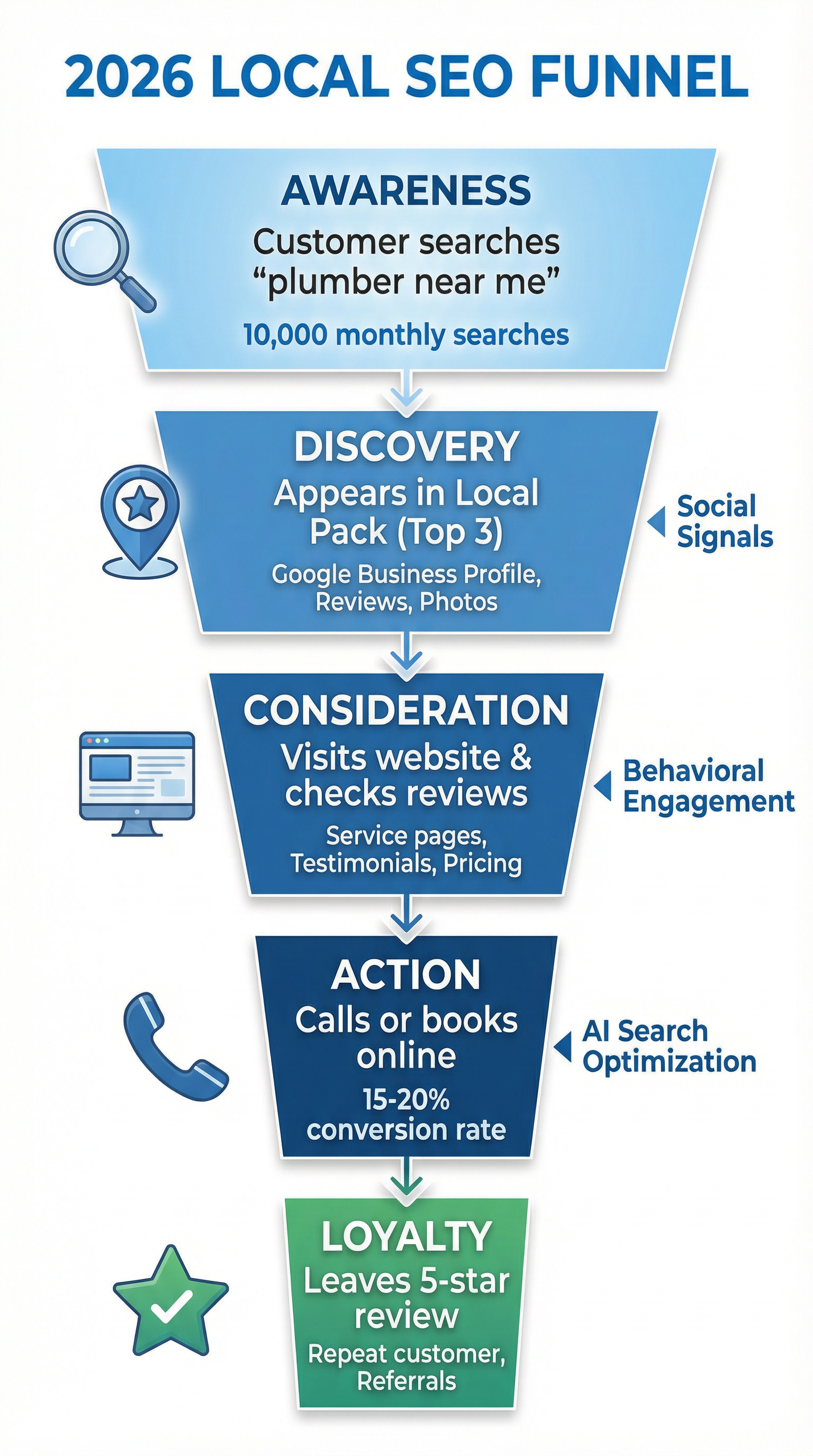
The complete customer journey showing how local SEO captures plumbers at every stage from initial search to repeat business.
📌 KEY TAKEAWAYS
After reading this guide, you’ll know how to:
- Optimize your Google Business Profile to appear in the Local Pack for high-intent searches like “emergency plumber near me”
- Identify and target the exact keywords your ideal customers are searching for in your service area
- Generate a consistent stream of 5-star reviews that boost your rankings and build trust
- Build local citations and backlinks that establish your authority in your market
- Leverage NEW 2026 ranking factors like social signals and behavioral engagement that your competitors are ignoring
- Measure your ROI and track the metrics that actually matter for your bottom line
- Avoid the costly mistakes that keep 80% of plumbers invisible online
Estimated reading time: 35 minutes | Last updated: January 2026
Part 1: Understanding Local SEO for Plumbers
What is Local SEO and Why It Matters
Local SEO is the practice of optimizing your online presence to appear prominently when people in your service area search for plumbing services. Unlike traditional SEO, which focuses on ranking nationally or globally, local SEO targets customers within a specific geographic radius—typically the cities, neighborhoods, and zip codes where you actually provide service.
Local SEO operates across three main channels that work together to capture customers at different stages of their search journey. First, your Google Business Profile appears in the Local Pack (also called the Map Pack)—those three business listings with map pins that appear at the top of search results. Second, your website pages can rank in local organic results below the Local Pack when optimized for location-specific keywords. Third, your business appears in Google Maps when customers search directly in the Maps app or click through from search results.
The distinction between local and traditional SEO matters enormously for service-area businesses like plumbing companies. Traditional SEO might help you rank for “how to fix a leaky faucet,” but local SEO ensures you appear when someone searches “plumber near me” or “emergency plumber in Dallas”—searches with immediate commercial intent from people ready to hire right now.
For plumbers specifically, local SEO is uniquely valuable because of the nature of your business. Plumbing emergencies create urgent, high-intent searches where customers need immediate help and are willing to pay premium prices. Service-area businesses can’t rely on foot traffic like retail stores—you need to intercept customers digitally at the exact moment they need your services. Research shows that 76% of people who search for something nearby on their smartphone visit a business within 24 hours, and 28% of those searches result in a purchase. For emergency plumbing services, these conversion rates are even higher because the need is immediate and unavoidable.
Consider what happens when someone searches “plumber near me” versus “plumbing tips.” The first search displays a map with three local plumbers, their ratings, phone numbers, and directions—everything needed to make an immediate hiring decision. The second search shows blog articles and DIY guides with no immediate commercial opportunity. Local SEO ensures you dominate the first type of search, where customers are ready to buy.
How Local Search Works in 2026
Understanding how Google determines which businesses appear in local search results is essential for optimizing your presence effectively. Local search has evolved significantly in 2026, incorporating new signals and technologies that change how plumbers need to approach their digital marketing.
The Local Pack (sometimes called the Map Pack or 3-Pack) is the most valuable real estate in local search. These three business listings appear at the very top of search results, above all organic results, with prominent map pins, star ratings, and direct action buttons for calling or getting directions. Studies show that Local Pack listings receive 44% of clicks on local search results pages, making this the primary target for local SEO efforts. The Local Pack appears for searches with clear local intent like “plumber in Chicago” or “emergency drain cleaning near me.”
Local organic results appear below the Local Pack and consist of traditional website listings optimized for local keywords. While these don’t have the same visual prominence as the Local Pack, they still capture significant traffic—especially for informational searches where users are researching before making a decision. Your service pages, location pages, and blog content compete for these positions.
Google Maps rankings have become increasingly important as mobile usage has grown. When someone searches directly in Google Maps or clicks “More places” in the Local Pack, they see an expanded list of businesses ranked by relevance and proximity. With over 70% of plumbing searches happening on mobile devices, Maps visibility is critical for capturing on-the-go customers dealing with emergencies.
Google evaluates local businesses based on three primary factors: Relevance (how well your business matches what the searcher is looking for), Distance (how close you are to the searcher or the location they specified), and Prominence (how well-known and authoritative your business is). Relevance is determined by your Google Business Profile categories, services, and description. Distance is straightforward geography, though service-area businesses can rank across their entire service area. Prominence is where most of the optimization work happens—it’s determined by your reviews, citations, backlinks, website quality, and the new 2026 factors we’ll discuss in detail later.
A major development in 2026 is the integration of AI-powered search experiences. Google’s Search Generative Experience (SGE) now occasionally features local businesses in AI-generated overviews, particularly for queries like “best plumber for water heater installation” or “most reliable emergency plumber near me.” These AI overviews pull information from your website, reviews, and structured data to create summaries that can drive significant traffic. Optimizing for AI search requires clear, factual content and comprehensive schema markup—topics we’ll cover in depth in the technical SEO section.
The ROI of Local SEO for Plumbing Businesses
One of the most common questions plumbing business owners ask is whether local SEO is worth the investment compared to other marketing channels. The data overwhelmingly shows that local SEO delivers the highest return on investment of any digital marketing strategy for service-area businesses.
Let’s compare the average cost per lead across different marketing channels:
| Marketing Channel | Average Cost Per Lead | Lead Quality | Long-Term Value |
|---|---|---|---|
| Local SEO | $0.50 – $2.00 | Very High | Compounds over time |
| Google Ads | $15 – $50 | High | Stops when budget runs out |
| Facebook Ads | $10 – $30 | Medium | Stops when budget runs out |
| Direct Mail | $50 – $100 | Low-Medium | One-time campaign |
| Lead Generation Sites | $25 – $75 | Low-Medium | Shared with competitors |
The dramatic difference in cost per lead tells only part of the story. Local SEO leads are typically higher quality because they’re actively searching for your specific services at the moment they need them. Unlike social media ads that interrupt people who weren’t thinking about plumbing, local SEO captures customers with immediate intent. Someone searching “emergency plumber Dallas” at 11 PM has a burst pipe and needs help right now—they’re not price shopping or casually browsing.
The long-term value proposition makes local SEO even more compelling. When you invest $2,000 per month in Google Ads, you get leads for that month. Stop paying, and the leads stop immediately. Local SEO works differently—it’s an asset that compounds over time. Your first three months of optimization work continues delivering results in month six, month twelve, and beyond. A plumbing company that invests $2,000 monthly in local SEO might generate 50-100 qualified leads per month after six months of optimization, representing $50,000-$150,000 in potential revenue. By month twelve, those same ongoing efforts might generate 100-200 leads monthly as your rankings strengthen and your online presence expands.
Consider a real-world example: A mid-sized plumbing company in a competitive market invests $2,000 per month in comprehensive local SEO. After six months, they rank in the Local Pack for 15 high-value keywords and on page one for 50+ related searches. They generate approximately 75 qualified leads per month from organic search. With a 50% close rate and an average job value of $500, they’re generating $18,750 in monthly revenue from SEO, representing a 9.4x return on investment. By month twelve, as their rankings strengthen and they rank for even more keywords, monthly leads increase to 120, generating $30,000 in revenue—a 15x ROI. And unlike paid advertising, these results continue even if they reduce their SEO investment to maintenance-level spending.
DIY vs Hiring an Agency
Plumbing business owners often struggle with the decision of whether to handle local SEO in-house or hire a specialized agency. Both approaches can work, but the right choice depends on your specific situation, resources, and goals.
When DIY Makes Sense:
Do-it-yourself local SEO is viable if you have a single location, operate in a less competitive market, have time to learn and implement strategies consistently, and are working with a limited budget. Many of the foundational tasks—claiming your Google Business Profile, building citations, requesting reviews—are straightforward and don’t require technical expertise. If you’re willing to invest 5-10 hours per week learning and implementing strategies, you can achieve solid results over 6-12 months.
The primary advantage of DIY is cost savings. Instead of paying $1,000-$2,500 monthly for an agency, you’re investing your time. For a new plumbing business with limited cash flow, this can make the difference between having a local SEO strategy and having none at all. Additionally, no one knows your business better than you do—you understand your customers, your service area, and your competitive advantages in ways an agency needs time to learn.
When to Hire an Agency:
Professional local SEO services make sense when you operate multiple locations (agencies can scale strategies across locations efficiently), compete in a highly competitive market where technical expertise matters, want faster results than DIY can deliver, or lack the time to learn and implement strategies consistently. Agencies bring specialized expertise, established processes, and access to premium tools that would be expensive to purchase individually.
The typical investment for professional local SEO services ranges from $1,000 to $2,500 per month, depending on market competitiveness, number of locations, and scope of services. This might seem expensive, but consider that a single emergency plumbing call can generate $500-$2,000 in revenue. If an agency helps you capture just 5-10 additional jobs per month, the investment pays for itself many times over.
| Factor | DIY Local SEO | Professional Agency |
|---|---|---|
| Monthly Cost | Your time (5-10 hrs/week) | $1,000-$2,500 |
| Time to Results | 6-12 months | 3-6 months |
| Technical Expertise | Learning curve required | Immediate expert implementation |
| Best For | Single location, smaller markets | Multiple locations, competitive markets |
| Ongoing Effort | Continuous time investment | Minimal oversight required |
A Hybrid Approach: Many successful plumbing companies use a hybrid model—hiring an agency for technical implementation and strategy while handling day-to-day tasks like posting to Google Business Profile and requesting reviews in-house. This combines agency expertise with your intimate knowledge of your business and customers.
Regardless of which approach you choose, understanding these strategies is valuable. If you hire an agency, this knowledge helps you evaluate their work, ask informed questions, and ensure you’re getting value for your investment. If you go the DIY route, this guide provides the roadmap you need to compete effectively.
Part 2: Mastering Your Google Business Profile
Your Google Business Profile is your plumbing company’s most powerful digital asset. It influences your rankings in Google Maps, the Local Pack, and service-area search results—making it the foundation of any SEO strategy for plumbers. Businesses with complete GBP listings receive seven times more clicks than incomplete profiles, making this optimization absolutely critical for capturing local plumbing leads.
How to Optimize Your GBP for Plumbing Leads
Complete Every Detail Thoroughly
Accuracy matters when homeowners are making split-second decisions about which plumber to call. Add your full NAP (Name, Address, Phone), website URL, comprehensive service area coverage, accurate business hours including emergency availability, and detailed descriptions of all service offerings. Every empty field is a missed opportunity to provide Google with ranking signals and give customers the information they need to choose your business.
Your business name should be exactly as it appears on your signage and legal documents—no keyword stuffing. Google explicitly prohibits names like “Joe’s Plumbing – Emergency Drain Cleaning Water Heater Repair” and will suspend profiles that violate this guideline. Use your actual business name and let the other fields do the SEO work.
The business description field gives you 750 characters to tell customers what makes your plumbing company special. Focus on your service area, specialties, years of experience, and unique value propositions. Include naturally placed keywords like “licensed plumber,” “24/7 emergency service,” “residential and commercial plumbing,” and specific services you offer. Write for humans first, search engines second. A compelling description might read: “Family-owned plumbing company serving Dallas and surrounding areas since 2010. Our licensed, insured plumbers specialize in emergency repairs, water heater installation, drain cleaning, and sewer line replacement. Available 24/7 for emergencies with same-day service for most repairs. Over 500 five-star reviews from satisfied customers.”
Use the Right Primary & Secondary Categories
Your category selection directly impacts which searches trigger your business listing. Select “Plumber” as your primary category to establish your core service, then strategically add secondary categories that match your specialties: Drain Cleaning Service, Sewer Line Contractor, Water Heater Installation Service, and Emergency Plumber. These categories help Google understand your full range of expertise and match you with high-intent customers searching for specific plumbing services.
Don’t add irrelevant categories hoping to capture more searches—this dilutes your relevance signals and can actually hurt your rankings for your core services. If you’re primarily a plumber, don’t add “HVAC Contractor” unless you truly offer comprehensive HVAC services with licensed technicians.
Add High-Quality Photos & Short Videos
Visual content builds trust and significantly improves profile engagement rates. Upload before-and-after photos showcasing completed projects, professional equipment shots that demonstrate your capabilities, team photos that humanize your business, and quick service videos showing your plumbers in action. Profiles with regular photo updates receive 42% more requests for directions and 35% more click-throughs to websites compared to profiles without visual content.
Aim for at least 20-30 high-quality photos covering different aspects of your business. Include photos of your service vehicles with clear company branding, your team in professional uniforms, completed installations (water heaters, fixtures, etc.), your tools and equipment, and your office or facility if customers visit. Add new photos at least weekly—fresh content signals an active, engaged business.
Videos are even more powerful for engagement. A 30-second clip showing your team responding to an emergency call, explaining a common plumbing problem, or highlighting your service process can differentiate you from competitors who only have static images. Videos don’t need professional production—authentic smartphone videos often perform better than overly polished corporate content.
Publish Consistent Google Posts
Regular Google Posts signal to both customers and search algorithms that your business is active and engaged. Promote seasonal plumbing specials, advertise drain cleaning discounts, highlight your 24/7 emergency service availability, and share educational plumbing tips that demonstrate expertise. Posts also provide valuable opportunities to naturally incorporate important plumbing SEO keywords while providing genuine value to potential customers.
Set up Google Business Profile posts on a weekly schedule. Plumbing companies that post at least once per week see 30% higher engagement rates and improved local pack visibility compared to businesses that post sporadically or not at all. Your posts should include a compelling image, 100-300 words of text, and a clear call-to-action button (Call, Learn More, Book, etc.).
Example post ideas include seasonal reminders (“Winter is coming! Schedule your water heater inspection before the cold weather hits”), service promotions (“This month only: $50 off any drain cleaning service”), educational content (“5 signs your water heater needs replacement”), emergency service reminders (“Burst pipe? We’re available 24/7 for emergency repairs”), and project showcases (“Just completed a whole-house repiping in [Neighborhood]—see the transformation!”).
Use the Q&A Section Strategically
The Q&A section is an often-overlooked goldmine for local SEO. Proactively post and answer common questions such as “Do you offer 24-hour emergency plumbing?”, “Do you service [specific city or neighborhood]?”, and “Can you install tankless water heaters?” This allows you to include semantically related keywords naturally while addressing the exact questions potential customers are asking before they even pick up the phone.
Don’t wait for customers to ask questions—seed your Q&A section with 10-15 common questions and provide detailed answers. This content appears prominently in your GBP listing and can influence both rankings and conversion rates. Questions like “What areas do you serve?”, “Do you offer free estimates?”, “Are you licensed and insured?”, and “What payment methods do you accept?” should all have clear, comprehensive answers.
Monitor your Q&A section regularly because anyone can post questions—including competitors trying to make you look bad. Respond to all legitimate questions within 24 hours, and flag inappropriate or spam questions for removal.
Understanding GBP Insights – Metrics That Matter
Google Business Profile Insights provides valuable data about how customers find and interact with your listing. Access Insights by logging into your GBP dashboard and clicking the “Insights” tab. This data helps you understand what’s working and where to focus your optimization efforts.
Key Metrics to Track:
Search Queries: See exactly what terms customers used to find your business. These are divided into “direct” searches (people specifically searching for your business name) and “discovery” searches (people searching for services you offer). A healthy ratio is 30-40% direct and 60-70% discovery. If you’re getting mostly direct searches, you need to improve your visibility for service-related keywords. If you’re getting mostly discovery searches with few direct searches, you need to work on brand awareness.
Profile Views: How many people viewed your GBP listing. A healthy plumbing GBP in a mid-sized market should see 500-2,000 monthly views depending on market size and competitiveness. Track this over time—steady growth indicates improving visibility, while declines suggest ranking problems or increased competition.
Actions: The specific actions customers took after viewing your profile—website clicks, direction requests, and phone calls. These are the metrics that directly impact your bottom line. Track your conversion rate (actions divided by views). If 1,000 people view your profile but only 50 take action, you have a 5% conversion rate. Industry benchmarks suggest 10-15% is healthy for plumbing companies. Low conversion rates indicate problems with your profile content, photos, or reviews.
Photo Views: How often customers view your photos versus competitors’ photos. High photo engagement correlates with higher overall profile engagement. If your photos are viewed significantly less than competitors, you need better quality or more frequent photo updates.
Direction Requests: How many people requested directions to your location. For service-area businesses, this number may be lower than for retail locations, but it still indicates serious intent—someone requesting directions is likely ready to visit or verify your legitimacy.
Phone Calls: The most valuable metric for plumbers. Track total calls and call trends over time. Most GBP calls are high-intent leads ready to book service. If your calls are declining while views are steady, you may have review problems or competitors with better profiles.
Check your Insights weekly and note which posts, photos, or profile updates correlate with spikes in engagement. If a post about emergency services generates 50% more calls than usual, create more content around that theme. Use this data to continuously refine your GBP strategy based on what actually drives customer actions.
Common GBP Mistakes That Kill Your Rankings
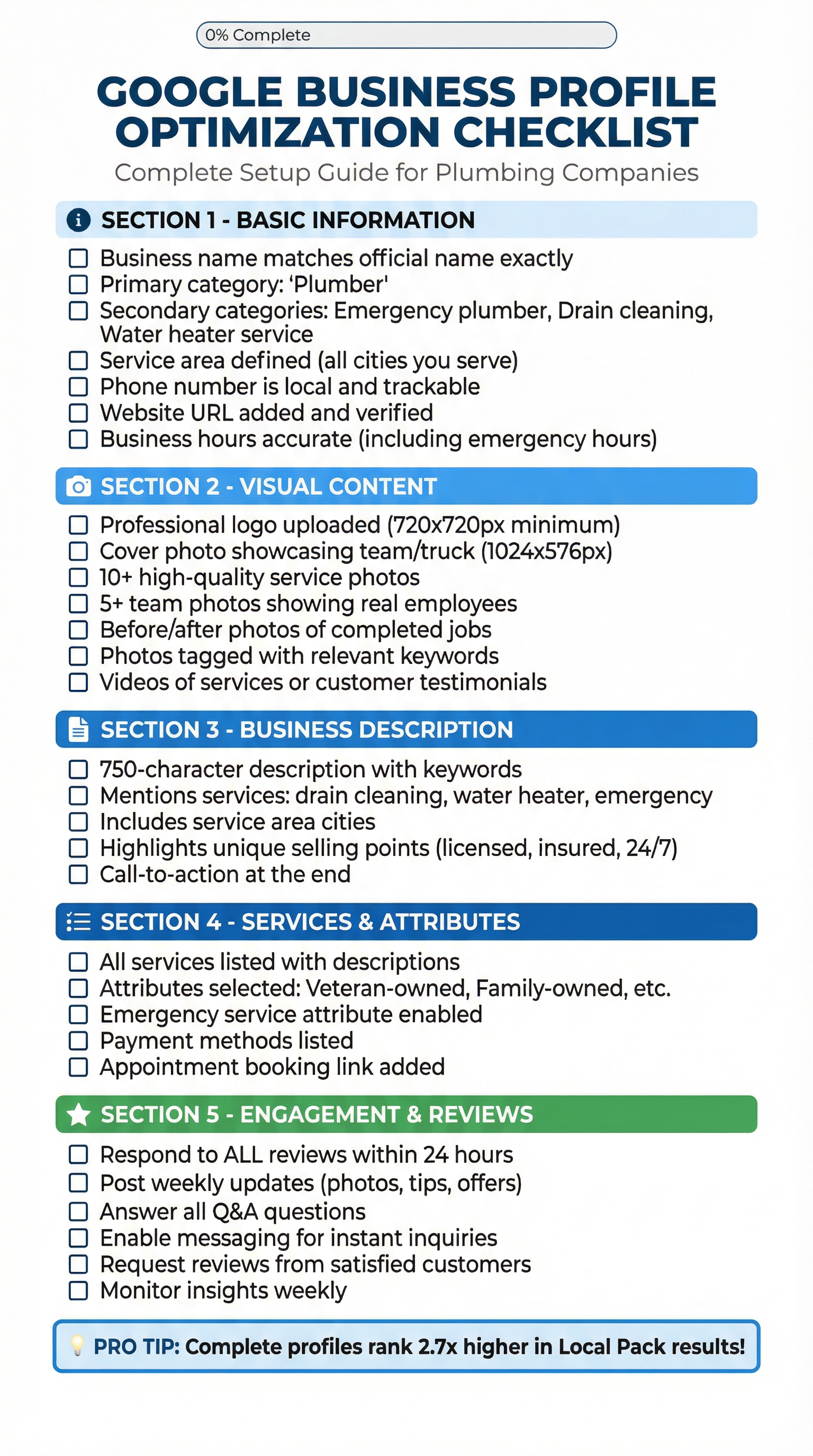
Download and use this comprehensive GBP optimization checklist to ensure your profile is fully optimized for maximum visibility.
Even experienced business owners make critical mistakes that can tank their local rankings or result in profile suspension. Avoid these common errors:
Keyword Stuffing in Business Name: Adding keywords to your business name (“Smith Plumbing | 24/7 Emergency Plumber | Drain Cleaning”) violates Google’s guidelines and can result in immediate suspension. Google suspended over 3 million business listings in 2024 for guideline violations—don’t risk your visibility. Use your actual business name only, and let your description, categories, and services do the keyword work.
Real example: A plumber changed their business name from “Smith Plumbing” to “Smith Plumbing | 24/7 Emergency Drain Cleaning Water Heater Repair” hoping to rank for more keywords. Within two weeks, Google suspended the listing. It took three months of appeals and verification to get reinstated, during which the business lost an estimated $40,000 in revenue from lost visibility.
Using a PO Box or Virtual Office: Google requires a physical address where customers can visit during stated hours (for businesses with a storefront) or where your business is actually based (for service-area businesses). Using a PO Box, UPS Store mailbox, or virtual office address violates guidelines and will result in suspension. If you’re a service-area business operating from home, you can hide your address from public view while still verifying with your actual location.
Inconsistent NAP Across the Web: Your Name, Address, and Phone number must be identical everywhere they appear online—your website, citations, social media, and GBP. Even small variations like “St.” vs “Street” or different phone numbers confuse Google and dilute your ranking signals. Audit your NAP consistency across all platforms and correct any discrepancies.
Creating Duplicate Listings: Never create multiple GBP listings for the same physical location, even if you offer different services or want to rank in multiple cities. Google will detect duplicates and suspend all listings. If you have multiple physical locations, each gets one listing. If you’re a service-area business, you get one listing covering your entire service area.
Ignoring Reviews or Responding Unprofessionally: Failing to respond to reviews—especially negative ones—signals that you don’t care about customer feedback. Responding defensively or argumentatively to negative reviews makes you look unprofessional and drives away potential customers. We’ll cover proper review management in detail in the reputation section.
Letting Your Profile Go Stale: If you haven’t updated your GBP in months—no new posts, photos, or responses to reviews—Google interprets this as a potentially closed or inactive business and may reduce your visibility. Consistent activity signals a thriving business worthy of prominent placement.
Part 3: Keyword Research and Strategy

Successful SEO for plumbers starts with understanding exactly how customers search when they need plumbing services. Your keyword strategy should reflect emergency intent, service-specific needs, and location-based modifiers that connect you with customers in your service area.
High-Intent Plumbing Keyword Examples
Different types of keywords serve different purposes in your overall strategy. Understanding these categories helps you create targeted content that captures customers at various stages of their journey.
| Keyword Type | Examples | Search Intent | Monthly Value |
|---|---|---|---|
| Emergency Keywords | “emergency plumber near me,” “24-hour plumber [city],” “burst pipe repair now” | Highest – immediate need | Very High |
| Service Keywords | “water heater repair [city],” “sewer line replacement [city],” “drain cleaning [neighborhood]” | High – specific service need | High |
| “Near Me” Keywords | “plumber near me,” “drain cleaning near me,” “leak detection near me” | High – ready to hire locally | High |
| Informational Keywords | “why is my water heater leaking,” “how to unclog a drain,” “cost to replace water heater” | Medium – researching/learning | Medium |
Emergency keywords represent your highest-value targets. Someone searching “emergency plumber Dallas” at 2 AM has an urgent problem and will hire whoever appears first and looks trustworthy. These searches convert at 60-80% rates compared to 20-30% for general service keywords.
Service-specific keywords target customers who know exactly what they need. “Water heater installation [city]” indicates someone ready to hire for that specific service. These keywords often have lower search volume than general terms but higher conversion rates because the intent is crystal clear.
“Near me” searches have exploded with mobile usage, now representing 30-40% of all local plumbing searches. These searchers want immediate, nearby help. Optimizing for “near me” searches requires strong GBP optimization and mobile-friendly website design.
Don’t ignore informational keywords like “how to fix a leaky faucet.” While these have lower immediate conversion intent, they allow you to capture customers early in their decision process and establish your expertise before the emergency happens. Someone researching how to fix their own leak often realizes they need professional help—if your helpful blog post is what they found, you’re the plumber they’ll call.
Keyword Research Data for Major Cities
Understanding search volumes in different markets helps you set realistic expectations and identify opportunities. Here’s actual monthly search volume data for major metropolitan areas:
| City | “Plumber [City]” | “Emergency Plumber [City]” | “Water Heater Repair [City]” | “Drain Cleaning [City]” |
|---|---|---|---|---|
| Los Angeles | 8,100/mo | 2,400/mo | 1,300/mo | 1,900/mo |
| Chicago | 5,400/mo | 1,600/mo | 880/mo | 1,200/mo |
| Houston | 4,900/mo | 1,400/mo | 720/mo | 1,100/mo |
| Phoenix | 3,600/mo | 1,000/mo | 590/mo | 820/mo |
| Philadelphia | 3,100/mo | 880/mo | 480/mo | 710/mo |
| San Antonio | 2,700/mo | 760/mo | 410/mo | 620/mo |
| San Diego | 2,400/mo | 680/mo | 370/mo | 550/mo |
| Dallas | 3,800/mo | 1,100/mo | 590/mo | 880/mo |
These numbers represent monthly search volume across all devices. Even smaller cities with 500-1,000 monthly searches for primary keywords can generate 20-50 high-quality leads per month for businesses that rank well. Don’t be discouraged if your market has lower search volumes—you need far fewer leads as a plumber than a retail business because your average transaction value is much higher.
Notice how emergency keywords represent 25-30% of the volume of general plumber searches. This makes sense—most plumbing needs aren’t emergencies, but emergency searches are your highest-value targets because of their urgency and high conversion rates.
Use professional SEO tools like Ahrefs, SEMrush, Google Keyword Planner, and Google Search Console to identify profitable local search terms that your competitors might be missing. Pay special attention to search volume trends, seasonal variations (frozen pipes in winter, AC drain issues in summer), and the specific language your local market uses.
Spying on Your Competitors’ Keywords
One of the fastest ways to identify keyword opportunities is analyzing what’s already working for your competitors. If a competitor ranks well for specific keywords, you can likely rank for those same terms with proper optimization.
Step-by-Step Competitor Keyword Analysis:
- Identify your top 3-5 local competitors (businesses ranking in the Local Pack or top 10 organic results for your target keywords)
- Enter their domain into Ahrefs or SEMrush
- Navigate to “Organic Keywords” section
- Filter by position 1-10 to see their best-performing keywords
- Sort by estimated traffic to identify their highest-value pages
- Export the keyword list and identify gaps—keywords they rank for that you don’t
Pro Tip: Focus on keywords where competitors rank #4-10. These positions indicate the keyword is achievable but not dominated by a single authority. Keywords where a competitor ranks #1-3 are harder to outrank and may require more time and resources.
Look for patterns in competitor keyword strategies. If multiple competitors rank well for “tankless water heater installation [city],” this indicates strong local demand for that service. If you offer tankless installation but don’t have a dedicated page for it, you’re missing opportunities.
Pay attention to the types of content that rank well. Are competitors ranking with service pages, blog posts, or location pages? This tells you what content format Google prefers for each keyword. If blog posts dominate “water heater repair cost” while service pages dominate “water heater repair [city],” you need different content strategies for each.
Once you’ve identified your target keywords, incorporate them strategically into your service pages, location-specific landing pages, Google Business Profile description and posts, blog articles and educational content, and citations across online directory listings. This comprehensive keyword integration helps Google connect your business to real search behavior patterns in your service area, improving your visibility for the searches that matter most.
Part 4: On-Page SEO and Website Optimization

If your plumbing company serves multiple cities, counties, or distinct neighborhoods, location-specific pages are essential for comprehensive local SEO coverage. These dedicated pages help you rank in each geographic market you want service calls from, multiplying your visibility across your entire service area.
Best Practices for Plumbing Location Pages
Use Unique Content for Each Area
Google penalizes duplicate content, so avoid the temptation to simply copy and paste the same description across multiple location pages. Instead, write unique descriptions that mention local neighborhoods, specific water system characteristics common to that area, or prevalent plumbing issues (such as older homes with clay pipes, hard water areas requiring specialized treatment, or neighborhoods with frequent tree root intrusion into sewer lines). This localization signals relevance to both search engines and local customers.
Each location page should include 500-800 words of unique content covering your services in that specific area, local landmarks or neighborhoods you serve, area-specific plumbing challenges, customer testimonials from that location, and your response time or service availability for that area.
Add Local Testimonials
People trust plumbers who have already successfully helped others in their specific community. Feature reviews and testimonials from customers in that particular location, ideally mentioning the neighborhood or city by name. This social proof is particularly powerful for plumbing services, where trust and reliability are paramount decision factors.
Example: “We called ABC Plumbing when our water heater failed on a Sunday morning. They had a technician at our Lakewood home within 90 minutes and installed a new unit the same day. Highly recommend for anyone in the Lakewood area!” — Sarah M., Lakewood
Include an Embedded Google Map
Add an embedded Google Map showing your service area or the specific neighborhood you’re targeting. This reinforces geographic relevance and helps customers visualize your coverage area. The map also provides additional local signals to search engines.
Optimize On-Page SEO Elements
Each location page needs proper on-page optimization to rank well. Your title tag should include your primary service and location: “Plumber in [City] | 24/7 Emergency Plumbing Services | [Company]”. The meta description should be compelling and include a call-to-action: “Need a licensed plumber in [City]? [Company] offers 24/7 emergency service, same-day repairs, and free estimates. Call now: [Phone].”
Use your target location in H1 and H2 headings naturally: “Professional Plumbing Services in [City]” as your H1, with H2s like “Emergency Plumber Serving [City] and Surrounding Areas” and “Why [City] Homeowners Choose [Company] for Plumbing Repairs.”
Technical SEO Essentials for Plumbers
Technical SEO might sound intimidating, but the fundamentals are straightforward and critically important for ranking well and converting visitors into customers.
Mobile Optimization: Over 70% of plumbing searches happen on mobile devices, often during emergencies when someone is frantically searching for help. If your website isn’t mobile-friendly, you’re losing the majority of your potential customers. Mobile optimization means your site automatically adjusts to fit any screen size, buttons and phone numbers are large enough to tap easily, text is readable without zooming, and navigation is simple and intuitive.
Test your mobile experience using Google’s Mobile-Friendly Test tool. If your site fails, prioritize fixing mobile issues immediately—this is costing you customers every single day.
Page Speed: Slow websites kill both rankings and conversions. Google uses page speed as a ranking factor, and customers abandon sites that take more than 3 seconds to load. For plumbers, where customers often search during stressful emergencies, a slow site means they’ll hit the back button and call your competitor instead.
Your service pages should load in under 3 seconds on mobile networks. Test your speed using Google PageSpeed Insights, which provides specific recommendations for improvement. Common quick wins include compressing images (large photos are the #1 cause of slow plumbing websites), enabling browser caching, using a content delivery network (CDN), and minifying CSS and JavaScript files.
Core Web Vitals: Google’s Core Web Vitals measure user experience through three specific metrics: Largest Contentful Paint (how quickly your main content loads), First Input Delay (how quickly your site responds to user interactions), and Cumulative Layout Shift (whether elements jump around as the page loads). These metrics directly impact rankings. Check your Core Web Vitals in Google Search Console and address any pages that fail these thresholds.
HTTPS Security: Google requires HTTPS (the padlock icon in the browser) as a ranking factor and displays warnings for non-secure sites. If your site still uses HTTP, upgrade to HTTPS immediately. Most hosting providers offer free SSL certificates through Let’s Encrypt, making this a simple, no-cost upgrade.
XML Sitemap and Robots.txt: Your XML sitemap tells Google which pages on your site to crawl and index. Create a sitemap using your website platform’s built-in tools or a plugin, then submit it to Google Search Console. Your robots.txt file tells search engines which pages not to crawl (like admin pages or duplicate content). Most plumbing websites can use a simple robots.txt that allows all important pages while blocking only administrative areas.
Schema Markup for Plumbers
Schema markup is structured data that helps Google understand your content more accurately. Think of it as providing Google with a detailed label for your business information, making it easier for search engines to display your information correctly in search results.
Essential Schema Types for Plumbers:
LocalBusiness Schema: Identifies your business type, location, contact information, and hours. This is the foundation of local SEO schema and should be on every page of your site.
Service Schema: Describes each service you offer with details about what’s included, service area, and pricing (if applicable). Create separate service schema for each major service: drain cleaning, water heater installation, emergency plumbing, etc.
FAQPage Schema: Marks up your frequently asked questions so they can appear as rich snippets in search results. FAQ rich snippets can increase click-through rates by 30-40% by making your listing more prominent and informative.
Review Schema: Displays your star rating in search results, making your listing stand out visually and building trust before customers even click.
Implement schema using JSON-LD format (the method Google recommends) either manually in your site’s code or through plugins like Schema Pro, Rank Math, or Yoast SEO. After implementation, test your schema using Google’s Rich Results Test to ensure it’s formatted correctly and eligible for rich snippets.
Content Marketing for Plumbers
Beyond service and location pages, a strategic blog can drive significant additional traffic and establish your expertise. Content marketing captures customers early in their research phase and builds trust before they need emergency services.
High-Value Blog Topics for Plumbers:
- “5 Signs You Need to Replace Your Water Heater” (search volume: 2,400/month)
- “How to Prevent Frozen Pipes This Winter” (search volume: 8,100/month, highly seasonal)
- “Tankless vs Tank Water Heater: Which is Right for Your Home?” (search volume: 1,900/month)
- “How Much Does Sewer Line Replacement Cost?” (search volume: 3,600/month)
- “What to Do When Your Toilet Won’t Stop Running” (search volume: 5,400/month)
- “Signs of a Hidden Water Leak in Your Home” (search volume: 1,300/month)
- “How to Unclog a Drain Without Chemicals” (search volume: 6,600/month)
- “When to Call a Plumber vs DIY” (search volume: 880/month)
- “How Often Should You Have Your Drains Cleaned?” (search volume: 720/month)
- “Understanding Your Home’s Plumbing System” (search volume: 1,100/month)
Focus on topics that match your services and have commercial intent. Someone researching “how much does sewer line replacement cost” is likely evaluating whether to hire a professional. Your helpful article that explains the factors affecting cost positions you as the expert they should call for a quote.
Publish 2-4 blog posts per month consistently. Each post should be 1,000-1,500 words, include relevant images, link to your service pages, and end with a clear call-to-action to contact you for service.
Part 5: Reviews and Reputation Management

Your online reputation directly impacts both your rankings and your conversion rates. Reviews are one of the most powerful ranking factors for local SEO, and they’re often the deciding factor when customers choose between you and a competitor.
Why Reviews Matter More Than Ever
Reviews influence local rankings in multiple ways. Google’s algorithm considers review quantity (total number of reviews), review velocity (how frequently you receive new reviews), review recency (how recent your latest reviews are), review ratings (your average star rating), and review diversity (reviews across multiple platforms, not just Google).
Beyond rankings, reviews dramatically impact conversion rates. Research shows that 93% of consumers read online reviews before choosing a local business, and 85% trust online reviews as much as personal recommendations. For plumbers specifically, where trust and reliability are critical, reviews can be the difference between a customer calling you or your competitor.
The 2026 Shift: Review Velocity and Recency Matter Most
A major change in Google’s local ranking algorithm in 2025-2026 has shifted emphasis from total review count to review velocity and recency. This means a business with 80 reviews and 3-4 new reviews each month will often outrank a business with 150 reviews but no new reviews in the past six months.
The Review Drought Problem: Going months without new reviews sends negative signals to Google. It suggests your business may be less active, providing fewer services, or experiencing quality problems that prevent customers from leaving positive feedback. Even if you have hundreds of old reviews, a review drought hurts your rankings.
Ideal Review Cadence: For plumbing companies, aim for 2-4 new reviews per month minimum. This demonstrates consistent activity and ongoing customer satisfaction. Larger companies in competitive markets should target 8-12 new reviews monthly. The key is consistency—steady flow matters more than occasional bursts.
Example Comparison: – Business A: 150 total reviews, 4.8-star average, but only 2 reviews in the past 6 months – Business B: 80 total reviews, 4.7-star average, with 3-4 new reviews every month
Business B will typically rank higher despite having fewer total reviews because the consistent flow of fresh reviews signals an active, thriving business that’s currently serving customers well.
How to Generate More Reviews Systematically
The biggest mistake plumbers make with reviews is asking inconsistently or only when they remember. You need a systematic process that requests reviews after every job.
Timing is Critical: Ask for reviews 1-2 hours after completing a job while the positive experience is fresh in the customer’s mind. Waiting days or weeks dramatically reduces response rates. If you use field service software like Housecall Pro, ServiceTitan, or Jobber, set up automated review requests that send via text or email as soon as you mark a job complete.
Make it Easy: The harder you make it to leave a review, the fewer you’ll receive. Send customers a direct link to your Google review page, not just instructions to “find us on Google.” Create a short, memorable URL like yourcompany.com/review that redirects to your Google review link. Include this URL in follow-up messages, on invoices, and on business cards.
Ask the Right Way: Your request should be personal, specific, and appreciative. Avoid generic “please review us” messages. Instead: “Hi [Name], thanks for choosing [Company] for your water heater installation today. We’re glad we could help! If you were happy with [Technician’s] service, we’d really appreciate if you could take 60 seconds to share your experience: [Review Link]. Your feedback helps other homeowners in [City] find reliable plumbing help.”
Incentivize Ethically: You cannot offer discounts, payments, or rewards in exchange for reviews—this violates Google’s policies and can result in penalties. However, you can enter reviewers into drawings for prizes (as long as you don’t require a positive review), donate to charity for each review received, or offer general appreciation without tying it to the review itself.
Automating Review Requests Without Violating Policies
Manual review requests work but are inconsistent and easy to forget during busy periods. Automation ensures every customer receives a request without requiring you to remember.
Compliant Automation Tools: – Housecall Pro: Sends automated text/email review requests after job completion – Jobber: Includes automated review campaigns in follow-up sequences – ServiceTitan: Offers reputation management with automated requests – Podium: Specializes in review generation via text message – BirdEye: Comprehensive reputation management platform
These tools integrate with your scheduling system and automatically send review requests based on job status. The key to compliance is that you’re asking all customers for reviews, not just those you think had positive experiences (review gating), and you’re not offering incentives tied to positive reviews specifically.
Template for Automated Review Request:
“Hi [Customer Name], this is [Your Name] from [Company]. Thanks for trusting us with your [service type] today! We hope everything is working perfectly. If you have 60 seconds, we’d love to hear about your experience: [Review Link]. Your feedback helps us improve and helps other [City] homeowners find reliable plumbing help. Thanks again for choosing [Company]!”
How to Handle Negative Reviews
Negative reviews are inevitable—even the best plumbing companies occasionally have unhappy customers. How you respond to negative reviews matters more than the reviews themselves.
Don’t Panic: One or two negative reviews among many positive ones won’t destroy your rankings. In fact, a perfect 5.0-star rating with hundreds of reviews can look suspicious—customers know that no business is perfect. A 4.7-4.9 average with a few negative reviews mixed in appears more authentic.
Respond Quickly: Reply to negative reviews within 24 hours if possible. Fast responses show that you take feedback seriously and care about customer satisfaction. Delayed responses or no response at all suggests you don’t care about problems.
Acknowledge and Apologize: Even if you think the customer is wrong, start by acknowledging their frustration and apologizing for their negative experience. “We’re sorry to hear about your experience” costs you nothing and de-escalates the situation.
Take it Offline: Provide a direct phone number or email and invite the customer to discuss the issue privately. “We’d like to make this right. Please call us directly at [phone] so we can discuss this further and find a solution.” This shows other readers that you’re willing to resolve problems while moving the potentially contentious conversation out of public view.
Never Argue or Get Defensive: Responding defensively or arguing with the reviewer makes you look unprofessional and drives away potential customers reading the exchange. Even if the review is completely unfair, maintain professionalism.
Example Response to Negative Review:
“Hi [Customer Name], we’re sorry to hear about your experience with our service. This doesn’t reflect the quality we strive for, and we’d like to make it right. Please call us directly at [phone] so we can discuss what happened and find a solution. We appreciate your feedback and the opportunity to improve. – [Your Name], [Company]”
If you successfully resolve the issue, politely ask if the customer would consider updating their review to reflect the resolution. Many customers will update negative reviews to positive ones if you handle the situation well.
Showcasing Reviews on Your Website
Don’t let your hard-earned reviews live only on Google. Showcase them prominently on your website to build trust with visitors who haven’t seen your Google profile yet.
Add a testimonials section to your homepage featuring 5-10 of your best reviews with customer names and locations. Create a dedicated reviews page with 20-30 testimonials organized by service type. Include relevant testimonials on each service page (water heater reviews on your water heater page, etc.). Embed your Google reviews widget to show real-time reviews directly from Google.
Use review schema markup to display your star rating in search results, making your organic listings more prominent and trustworthy. This can increase click-through rates by 20-30% compared to listings without star ratings.
Part 6: 2026 Update – New Local Ranking Factors You Can’t Ignore
If you optimized your local SEO in 2023 and haven’t touched it since, you’re already falling behind. The 2026 local search landscape looks dramatically different, with new ranking factors that are reshaping which businesses dominate local results.
Whitespark’s 2026 Local Search Ranking Factors report revealed major shifts in what drives local visibility. Social signals and behavioral engagement now account for an estimated 25-30% of local ranking factors, up from virtually zero in 2023. For plumbers who adapt quickly to these changes, this represents a massive opportunity to outrank competitors who are still using outdated strategies.
Social Signals: The Game-Changing New Ranking Factor
For the first time in local SEO history, social media engagement has been officially recognized as a ranking factor. Whitespark’s 2026 survey of leading local SEO experts confirmed what many have suspected—businesses that maintain active, localized social media presence with consistent engagement are seeing measurable visibility benefits in local search results.
Why Google Now Cares About Social Signals:
Social media activity validates that you’re a real, active business serving a real community. Unlike website content that you fully control, social media requires genuine engagement from real people—likes, comments, shares, and follows that are difficult to fake at scale. This makes social signals a reliable indicator of business legitimacy and community presence.
Social engagement drives brand searches, which are powerful ranking signals. When customers see your helpful Facebook post about preventing frozen pipes and later search for your business name specifically, Google interprets this as a strong relevance signal. Brand searches indicate that people know your business and actively seek you out, suggesting you’re a prominent local business worthy of high rankings.
Social profiles often rank in search results for your brand name, expanding your search presence. When someone searches “ABC Plumbing Dallas,” they might see your website, Google Business Profile, Facebook page, and Instagram profile all on page one. This comprehensive presence builds trust and makes you appear more established than competitors with minimal online presence.
Platforms like Nextdoor have direct integration with local search. Active businesses on Nextdoor receive visibility benefits in Google’s local algorithm because Nextdoor validates your neighborhood presence and community engagement.
Platform-Specific Strategies for Plumbers:
Facebook Strategy (Your Primary Platform):
Facebook remains the most important social platform for local service businesses. Create a business page (not just a personal profile) and treat it as an extension of your marketing presence. Post 2-3 times per week with a mix of content types: before-and-after photos of completed projects, helpful tips and seasonal reminders, team highlights and company culture, special promotions and service offerings, and customer testimonials and success stories.
Join and actively engage in local community groups. Most cities have Facebook groups for homeowners, neighborhood associations, and local recommendations. Don’t spam these groups with promotional posts—instead, provide helpful advice when people ask plumbing questions and mention your services naturally when appropriate. Example: When someone posts “Can anyone recommend a good plumber?”, respond with “Hi! I own ABC Plumbing and we’d be happy to help. We specialize in [relevant service] and offer [unique value proposition]. Feel free to call us at [phone] or check out our reviews at [link].”
Use Facebook’s service area targeting to ensure your posts reach people in your service area. This is especially valuable for promoted posts or ads, but organic posts also benefit from proper location settings.
Respond to messages within one hour whenever possible. Facebook awards badges to businesses that respond quickly, and these badges appear on your profile, building trust with potential customers. Many plumbing emergencies start with a Facebook message from someone researching options before calling.
Example Facebook Posts:
“Just finished a slab leak repair in Lakewood! These hidden leaks can waste hundreds of gallons of water before you notice them. Signs to watch for: unexplained increases in your water bill, warm spots on your floor, or the sound of running water when all fixtures are off. If you notice any of these signs, call us for a free leak detection inspection: [phone]. #LakewoodPlumber #SlabLeakRepair”
“❄️ Freeze warning tonight! Protect your pipes: Let faucets drip slightly, open cabinet doors under sinks to allow warm air circulation, and disconnect outdoor hoses. If your pipes do freeze, DON’T use a torch or open flame to thaw them—call us for safe professional thawing: [phone]. Stay warm, [City]! #PlumbingTips #FreezePrevention”
Instagram Strategy (Visual Showcase):
Instagram is a visual platform perfect for showcasing your work through before-and-after transformations. Post 3-5 times per week to maintain consistent presence. Use Instagram Stories daily for behind-the-scenes content, quick tips, and team culture. Stories disappear after 24 hours, making them perfect for casual, authentic content that doesn’t need to be polished.
Use local hashtags on every post to increase discoverability: #[City]Plumber, #[City]HomeServices, #[Neighborhood]Business, #[City]SmallBusiness. Research which local hashtags are most active in your market and use a mix of popular and niche tags.
Location tags are critical—tag your location on every post. When someone browses Instagram posts tagged in your city or neighborhood, your content appears, increasing local visibility.
Instagram Reels and short videos perform best in the algorithm. Create 15-60 second videos showing “day in the life” content, “how we fixed this emergency” walkthroughs, “tool of the week” features, or quick plumbing tips. These don’t need professional production—authentic smartphone videos often perform better than overly polished content.
Engage with local businesses and potential customers by liking and commenting on posts from local accounts. This builds community connections and increases your visibility in local feeds.
Nextdoor Strategy (Hyper-Local Engagement):
Nextdoor is specifically designed for neighborhood-level engagement, making it incredibly valuable for service-area businesses like plumbers. Claim your business profile on Nextdoor and complete all profile information. Become a Nextdoor Local Deal provider to offer exclusive deals to neighbors, which increases your visibility in the platform.
Respond to recommendations and questions in your neighborhoods. When neighbors ask for plumber recommendations, you’ll receive a notification if you’re a claimed business. Respond helpfully and professionally, highlighting your relevant experience and local presence.
Share helpful tips regularly, but don’t make every post promotional. The Nextdoor community values genuinely helpful content. Example: “Reminder for [Neighborhood] residents: With freezing temps coming this weekend, here’s how to protect your pipes…” This positions you as a helpful neighbor who happens to be a plumber, not just a business trying to sell services.
Nextdoor has direct integration with Google’s local algorithm. Active businesses on Nextdoor receive visibility benefits because the platform validates your neighborhood presence and community engagement in ways that other social platforms don’t.
LinkedIn Strategy (B2B Opportunities):
While often overlooked for local service businesses, LinkedIn is valuable for commercial plumbing opportunities. Connect with property managers, facility managers, general contractors, real estate investors, and commercial property owners. Share industry insights, company updates, and thought leadership content that positions you as an expert in commercial plumbing.
LinkedIn is particularly valuable if you offer commercial services alongside residential plumbing. A strong LinkedIn presence can generate high-value commercial contracts that dramatically exceed typical residential job values.
Measuring Social Signal Impact:
Track brand searches in Google Search Console to see if social activity correlates with increased branded searches. An increase in people searching for your business name specifically indicates that your social presence is driving awareness and interest.
Monitor referral traffic from social platforms in Google Analytics. Set up goals to track conversions from social traffic. While social visitors may convert at lower rates than search visitors, they’re still valuable leads who discovered your business through community engagement.
Watch for correlation between social activity spikes and ranking improvements. If you launch a consistent social media strategy and see ranking improvements 30-60 days later, social signals are likely contributing to your success.
Pro Tip: Don’t try to be everywhere at once. Choose 1-2 platforms where your customers actually are (Facebook and Nextdoor for most plumbers), post consistently for 90 days, and measure results before expanding to additional platforms. Consistent presence on two platforms beats sporadic activity across five platforms.
Behavioral Engagement: Optimizing for User Actions
Google increasingly uses real user behavior to validate that businesses deserve high rankings. It’s no longer just about what you say about yourself—it’s about how users actually interact with your business online.
Key Behavioral Signals Google Tracks:
Google Business Profile Engagement Metrics:
Click-to-call rate: The percentage of people who view your profile and click your phone number to call. This is one of the strongest engagement signals because it indicates immediate intent to hire. Optimize by making your phone number prominent, ensuring it’s formatted correctly for mobile click-to-call, and using a compelling business description that encourages calls.
Direction requests: How many people request directions to your location. While less relevant for service-area businesses than retail locations, direction requests still indicate serious intent—someone requesting directions is likely verifying your legitimacy or planning to visit your office.
Website clicks: The click-through rate from your GBP to your website. High website click rates indicate that your profile is compelling enough to drive further research. Optimize by using high-quality photos that showcase your professionalism, maintaining a strong review profile that builds trust, and writing a compelling business description that makes people want to learn more.
Photo views: How often people view your photos compared to competitors’ photos. High photo engagement correlates with higher overall profile engagement. Regularly upload fresh, high-quality photos to maintain engagement.
Post engagement: Clicks and interactions with your Google Posts. Posts with strong engagement signals boost your overall profile authority. Create posts with compelling headlines, clear calls-to-action, and relevant offers or information.
Search queries: The specific terms people use to find your profile, divided into “direct” (branded searches) and “discovery” (service searches). A healthy ratio is 30-40% direct and 60-70% discovery, indicating both strong brand awareness and good visibility for service-related searches.
How to Optimize GBP Behavioral Signals:
Make your phone number prominent and clickable in your GBP description and posts. Use compelling photos that showcase your work, team, and professionalism—photos drive engagement more than any other element. Write engaging post headlines that encourage clicks: “Emergency Plumbing Available Now” performs better than “We Offer Plumbing Services.” Include clear calls-to-action in your business description and posts: “Call now for same-day service” or “Click to schedule your free estimate.”
Post during peak search times for plumbing services: early morning (6-9 AM when people discover problems before work), evenings (6-9 PM when people are home and notice issues), and weekends (when emergencies happen and people have time to address non-urgent repairs). Respond to all messages and reviews quickly—response speed is itself an engagement signal that Google tracks.
Website Engagement Metrics:
Time on site: How long visitors stay on your website. Longer time on site indicates valuable, engaging content. Google uses this as a quality signal—if visitors immediately bounce back to search results, your site probably didn’t meet their needs. Optimize by creating genuinely helpful content, using clear formatting with short paragraphs and bullet points, adding relevant images and videos, and ensuring fast load times so visitors don’t leave out of frustration.
Bounce rate: The percentage of visitors who leave after viewing only one page. High bounce rates suggest your content doesn’t match search intent or your site has usability problems. Optimize by ensuring your content matches the keywords you’re targeting, adding clear calls-to-action, improving page load speed, and creating compelling internal links that encourage visitors to explore multiple pages.
Pages per session: How many pages visitors view during a single visit. More pages per session indicates engaging content and good site navigation. Optimize by adding relevant internal links throughout your content, creating a clear navigation structure, and using related content suggestions at the end of articles.
Conversion actions: Form submissions, phone calls, chat interactions, and other goal completions. These are the ultimate behavioral signals because they indicate visitors found your site valuable enough to take action. Optimize by making contact forms simple and prominent, adding click-to-call buttons on mobile, using live chat to engage visitors immediately, and creating compelling calls-to-action throughout your site.
Return Visitor Rate:
Google tracks how many people return to your website or GBP after their first visit. High return rates signal that you’re a trusted resource people reference multiple times. This is particularly valuable for plumbing businesses because someone might research options, compare several plumbers, and then return to the one they trust most to actually book service.
Strategy to increase return visitors: Create valuable reference content people want to bookmark, such as comprehensive maintenance checklists, seasonal preparation guides, emergency procedure instructions, and cost estimation tools. Build an email list to bring people back through newsletters and helpful tips. Offer resources like downloadable guides that provide ongoing value.
Pro Tip: The fastest way to improve behavioral signals is making your site blazingly fast on mobile and adding prominent “Call Now for Emergency Service” buttons at the top of every page. These two changes alone can dramatically improve engagement metrics within weeks.
AI Search Readiness: Preparing for the Future
By 2026, an estimated 25-30% of searches may go through AI interfaces like Google’s Search Generative Experience (SGE), ChatGPT, Perplexity, and other AI-powered search tools. These platforms fundamentally change how search works, and plumbers who optimize for AI search now will dominate this emerging channel while competitors scramble to catch up.
How AI Search Differs from Traditional Search:
Traditional search shows a list of links and lets users decide which to click. AI search provides direct answers synthesized from multiple sources, often citing specific businesses as recommendations. When someone asks an AI “Who’s the best emergency plumber in Dallas?”, the AI might respond: “Based on customer reviews and service offerings, ABC Plumbing is highly rated for emergency service in Dallas, with 24/7 availability and over 500 five-star reviews. They specialize in burst pipe repairs and water heater emergencies.”
For your business to be featured in these AI-generated responses, AI systems need to confidently understand and cite your information. This requires optimization specifically for machine understanding, not just human readers.
How to Optimize for AI Search:
Structured Data is Critical: AI systems rely heavily on structured data (schema markup) to understand your business. Implement comprehensive LocalBusiness schema with detailed information about your services, service area, hours, and contact information. Add Service schema for each major service offering with clear descriptions of what’s included. Use FAQPage schema for your frequently asked questions—AI systems love pulling answers from well-structured FAQs. Include Review schema to help AI understand your reputation and customer satisfaction.
Clear, Factual Content: AI prefers clear, direct answers over flowery marketing copy. Instead of “We’re the best plumbers around,” say “Licensed, insured plumbers serving Dallas County since 2010 with 500+ five-star reviews and 24/7 emergency service.” AI can confidently cite the second statement because it contains specific, verifiable facts.
Structure your content to directly answer common questions. Use question-based headings like “How much does water heater installation cost?” followed by clear, factual answers. This format makes it easy for AI to extract and cite your information.
Authoritative Citations: AI systems look for signals of expertise and authority to determine which sources to trust and cite. Display licenses, certifications, and industry affiliations prominently on your website. Get listed in authoritative directories like BBB, Angi, and industry associations. Build a strong review profile across multiple platforms—AI systems check review data to validate quality. Earn mentions from trusted local sources like news sites, community organizations, and established local businesses.
Natural Language Optimization: AI search is often conversational, with users asking questions in natural language rather than typing keywords. Optimize for conversational queries like “Who’s the best emergency plumber near me?” or “How much does it cost to replace a water heater?” Include question-based content that matches how people actually speak when asking AI systems for recommendations.
Comprehensive FAQ Sections: AI search tools frequently pull answers from FAQ sections because they’re structured as clear question-answer pairs. Add 15-20 detailed FAQs to your website covering common questions about your services, pricing, service area, availability, and qualifications. Use FAQPage schema markup to make these questions easily discoverable by AI systems.
Pro Tip: AI search tools often cite businesses with comprehensive FAQ sections. Adding 15-20 detailed FAQs with proper schema markup can dramatically increase your chances of being featured in AI-generated answers, potentially capturing customers before they even see traditional search results.
The Compound Effect: Why These Factors Work Together
These new ranking factors don’t work in isolation—they create a virtuous cycle that accelerates your rankings and visibility over time. Understanding this compound effect helps you see why consistent effort across all these areas delivers exponentially better results than focusing on just one factor.
The Local SEO Virtuous Cycle:
You post helpful content on social media about preventing frozen pipes. Local homeowners engage with the post, sharing it with neighbors and commenting with questions. Some of these people remember your business name and later search for “ABC Plumbing Dallas” specifically (branded search). These branded searches signal to Google that you’re a prominent local business people actively seek out.
When these customers find your Google Business Profile, they’re already familiar with your brand from social media, so they’re more likely to click your phone number, request directions, or visit your website (high engagement signals). Some call immediately and book service. After you complete the job, they leave a positive review because they already felt connected to your brand from social media.
Google sees all these positive signals—social engagement, branded searches, high GBP engagement, website visits, and fresh reviews—and rewards you with better rankings. Better rankings bring more visibility to new customers who weren’t already familiar with your brand. These new customers discover you, have positive experiences, leave reviews, and potentially follow you on social media. The cycle accelerates.
More customers mean more reviews and social proof. More reviews mean better rankings. Better rankings mean more visibility. More visibility means more customers. Each element reinforces the others, creating momentum that becomes increasingly difficult for competitors to overcome.
The Power of Consistency:
The plumbers dominating local search in 2026 aren’t doing one thing exceptionally well—they’re doing many things consistently well. They post on social media 2-3 times per week. They request reviews after every job. They update their Google Business Profile weekly. They publish helpful blog content monthly. They respond to reviews and messages within hours. They maintain fast, mobile-friendly websites.
None of these individual actions is revolutionary, but the compound effect of consistent execution across all these areas creates an insurmountable competitive advantage. A competitor might match your review count, but can they also match your social engagement, website quality, content marketing, and behavioral signals? The combination of factors is what creates dominance.
Key Insight: Start with one or two areas where you can be genuinely consistent, then gradually expand. It’s better to post on Facebook twice a week for six months than to post daily for two weeks and then abandon it. Consistency beats intensity in local SEO because Google rewards sustained effort and ongoing activity, not short-term bursts followed by silence.
Part 7: Local Citations and Directory Listings
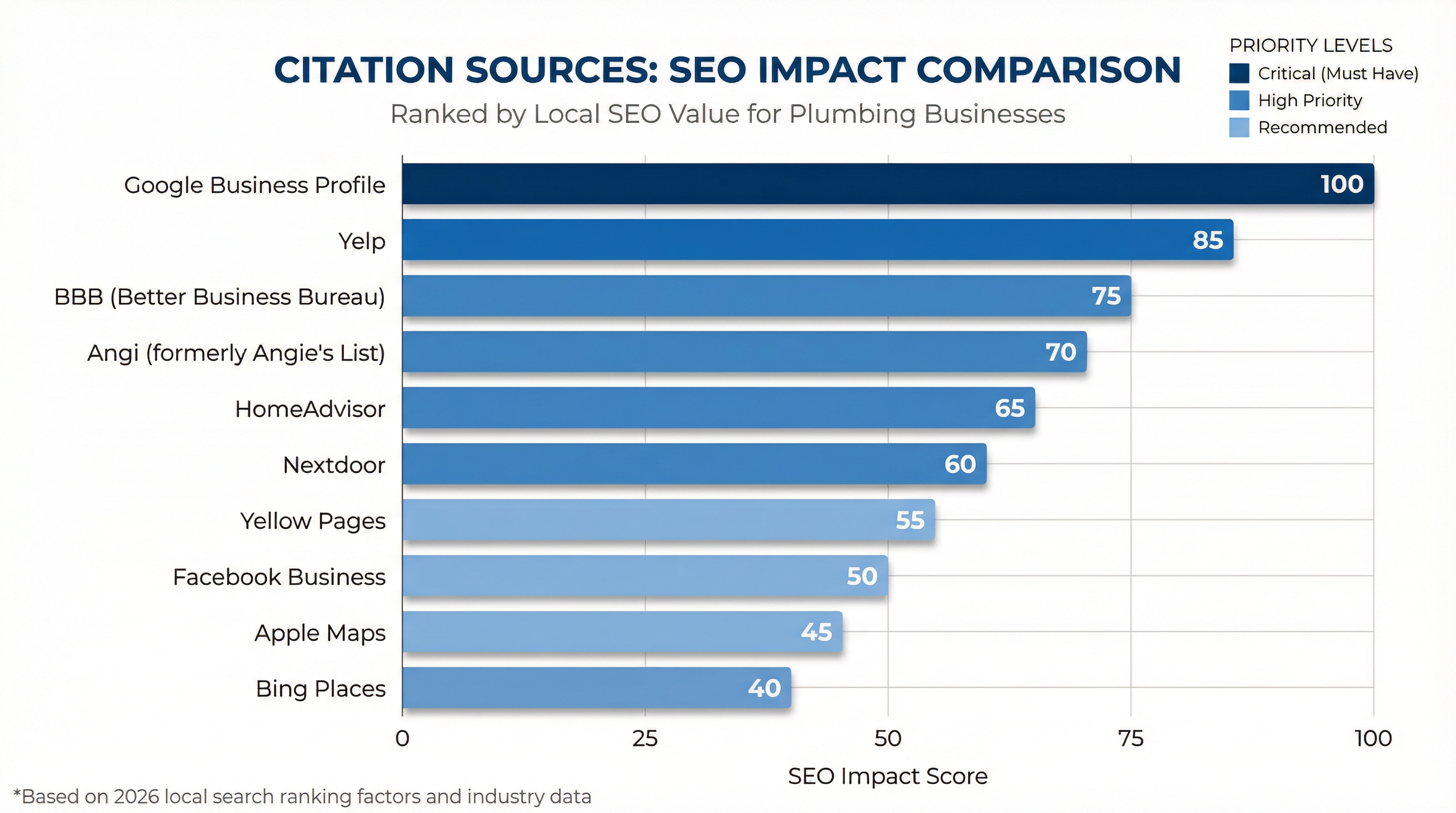
Priority ranking of citation sources based on their SEO impact for plumbing companies in 2026.
A local citation is any mention of your business’s name, address, and phone number (NAP) on other websites. Citations help Google verify that your business is legitimate and understand where you’re located and what services you offer. While citations aren’t as powerful as they were five years ago, they remain an important foundation of local SEO.
Top Directories for Plumbing Companies
Not all directories are created equal. Focus your efforts on high-quality, relevant directories rather than trying to get listed everywhere.
Essential General Directories (Priority 1): – Google Business Profile (already covered) – Bing Places for Business – Apple Maps (via Apple Business Connect) – Facebook Business Page – Yelp
Industry-Specific Directories (Priority 2): – Angi (formerly Angie’s List) – HomeAdvisor – Thumbtack – Porch – Houzz (if you do bathroom/kitchen remodeling)
Local Directories (Priority 3): – Better Business Bureau (BBB) – Local Chamber of Commerce – City/county business directories – Nextdoor – Local news site business directories
Professional Associations (Priority 4): – Plumbing-Heating-Cooling Contractors Association (PHCC) – State plumbing associations – Local trade organizations
Start with Priority 1 directories, ensuring your NAP information is identical across all of them. Then work through Priority 2 and 3 directories over several months. Don’t rush—adding 5-10 citations per month looks more natural to Google than suddenly appearing in 100 directories overnight.
NAP Consistency: Why It’s Critical
Your Name, Address, and Phone number must be identical everywhere they appear online. Even small variations confuse Google and dilute your ranking signals.
Common NAP Inconsistencies to Avoid: – “Street” vs “St” vs “St.” – “Suite 100” vs “Ste 100” vs “#100” – Different phone numbers (office vs mobile vs tracking numbers) – Business name variations (“ABC Plumbing” vs “ABC Plumbing LLC” vs “ABC Plumbing Company”)
Choose one standardized format and use it everywhere. If your Google Business Profile says “123 Main Street Suite 100,” every other citation should match exactly. If you’ve already built citations with inconsistent information, go back and update them to match your standardized format.
How to Audit Your Existing Citations
Before building new citations, audit your existing ones to identify inconsistencies, duplicates, and incorrect information.
Manual Audit Method: 1. Google your business name + city 2. Check the first 3 pages of results 3. Note any listings with incorrect information 4. Claim and correct each listing
Tool-Based Audit: – Moz Local ($129/year) – Scans 15+ major data aggregators – BrightLocal ($29-$79/month) – Comprehensive citation tracking – Whitespark ($20/month) – Citation finder and tracker
Look for wrong phone numbers, old addresses (if you’ve moved), inconsistent business names, duplicate listings for the same location, and listings on low-quality spam directories that might hurt more than help.
Citation Building Strategy
Build citations gradually and strategically rather than all at once.
Recommended Pace: – Month 1: Top 10 essential directories (Google, Bing, Apple, Facebook, Yelp, BBB, etc.) – Month 2: Industry-specific directories (Angi, HomeAdvisor, Thumbtack, etc.) – Month 3: Local directories (Chamber of Commerce, local news sites, community organizations) – Month 4+: Niche and supplementary directories
This gradual approach looks natural to Google and avoids triggering spam filters. It also spreads the work over time, making it manageable if you’re doing it yourself.
Quality Over Quantity: Fifty citations in high-quality, relevant directories are more valuable than 200 citations in low-quality spam directories. Focus on directories that real customers actually use and that have high domain authority. Avoid automated citation services that submit to hundreds of low-quality directories—these can actually hurt your rankings by associating your business with spam networks.
Part 8: Local Link Building for Plumbers
Backlinks—links from other websites to yours—remain one of the most powerful ranking factors in SEO. For local businesses, links from relevant local websites carry extra weight because they validate your local presence and community connections.
Why Backlinks Matter for Local SEO
Backlinks serve as votes of confidence from other websites. When a local news site, chamber of commerce, or supplier links to your website, they’re essentially vouching for your legitimacy and quality. Google interprets these links as trust signals and rewards you with higher rankings.
Quality matters dramatically more than quantity. One link from your local newspaper’s website is worth more than 100 links from low-quality spam directories. Focus on earning links from high-authority, relevant websites rather than accumulating as many links as possible.
Local links carry extra weight for local rankings. A link from a website in your city or state is more valuable for local SEO than a link from a national website with no local connection. This is why local link building strategies focus on community connections, local partnerships, and regional media.
7 Untapped Link Building Opportunities for Plumbers
1. Local News and Press Coverage
Local media outlets are always looking for interesting stories, and plumbers have more newsworthy angles than you might think.
Newsworthy Angles: – Hiring locally (especially if you’re adding multiple positions) – Community service projects (donating services to nonprofits, helping seniors, etc.) – Unique or challenging projects (historic building restoration, unusual emergency response) – Emergency response during disasters (helping during freeze events, floods, etc.) – Business milestones (anniversaries, expansion, awards) – Expert commentary on local issues (water quality problems, infrastructure issues)
How to Pitch: Send press releases to local news outlets, community newspapers, and TV stations. Make your pitch newsworthy by focusing on community impact, not self-promotion. “Local Plumber Donates Services to Senior Center” is newsworthy. “ABC Plumbing Offers Great Service” is not.
Even small mentions with a link are valuable. A brief mention in a local news roundup or community events section provides a high-quality local backlink.
2. Supplier and Manufacturer Partnerships
Many suppliers and manufacturers maintain “dealer locator” or “certified installer” pages on their websites. These are high-authority, relevant links that are relatively easy to obtain.
How to Get These Links: – Contact manufacturers of products you install (Rheem, Kohler, American Standard, etc.) – Ask about dealer/installer programs and directory listings – Complete any required certifications or training – Request to be added to their website’s dealer locator
These links are valuable because they come from high-authority domains and are relevant to your industry. A link from Rheem.com or Kohler.com carries significant weight for plumbing-related searches.
3. Local Business Associations
Joining your local chamber of commerce, Better Business Bureau, and trade associations typically includes a website listing with a link to your site.
Valuable Associations for Plumbers: – Local Chamber of Commerce – Better Business Bureau (BBB) – Plumbing-Heating-Cooling Contractors Association (PHCC) – State plumbing associations – Local business improvement districts – Rotary Club or similar service organizations
Beyond the direct link value, these associations provide networking opportunities that can lead to additional links and partnerships. Attend events, volunteer for committees, and build relationships with other local business owners who might link to your site or refer customers.
4. Community Sponsorships
Sponsoring local sports teams, school events, charity fundraisers, and community organizations typically includes sponsor recognition with a website link.
Sponsorship Opportunities: – Youth sports teams (Little League, soccer, etc.) – School events and fundraisers – Local charity runs or community events – Nonprofit organizations – Community festivals or celebrations
Choose sponsorships that align with your values and target market. Sponsoring a Little League team for $500 not only earns you a link from the league’s website but also builds brand awareness among local families—your target customers.
5. Guest Posting on Industry Blogs
Write helpful articles for home improvement blogs, real estate sites, property management resources, and local community websites.
Topic Ideas: – “10 Things Property Managers Should Know About Plumbing Maintenance” (for property management blogs) – “Essential Plumbing Inspections for Home Buyers” (for real estate blogs) – “How to Prepare Your Home’s Plumbing for Winter” (for local community sites) – “The True Cost of Delaying Plumbing Repairs” (for home improvement blogs)
Focus on providing genuine value, not self-promotion. Include an author bio with a link to your website. Even if the article itself doesn’t include links, the author bio link is valuable.
6. Resource Page Link Building
Many websites maintain “resources” or “recommended vendors” pages for their audience. These are perfect link opportunities for local service businesses.
How to Find Resource Pages: – Google “[your city] resources” – Google “recommended plumbers [your city]” – Look for real estate agent resource pages – Check property management company websites – Find home inspector recommended vendor lists
Outreach Template: “Hi [Name], I noticed your resource page for [City] homeowners at [URL]. I’m the owner of [Company], a licensed plumbing company serving [City] since [Year]. We specialize in [services] and have over [X] five-star reviews from local customers. Would you consider adding us to your resource list? I think your audience would find our [specific resource/guide] helpful: [URL]. Thanks for considering! [Your Name]”
7. Broken Link Building
Find broken links on relevant websites and suggest your content as a replacement.
How It Works: 1. Find relevant websites (plumbing industry sites, local business directories, home improvement resources) 2. Use tools like Check My Links (Chrome extension) or Ahrefs to find broken links 3. Create content similar to what the broken link pointed to (if you don’t already have it) 4. Reach out suggesting your content as a replacement
Outreach Template: “Hi [Name], I was reading your article on [topic] at [URL] and noticed a broken link in the section about [topic]. The link to [broken URL] returns a 404 error. I have a similar resource that might be a good replacement: [your URL]. It covers [what your content covers] and might be helpful for your readers. Either way, thought you’d want to know about the broken link. Thanks! [Your Name]”
Broken link building has a high success rate because you’re helping the website owner fix a problem while suggesting your content as a solution.
Part 9: Measuring Success and ROI
Tracking the right metrics helps you understand what’s working, where to focus your efforts, and how to demonstrate ROI to stakeholders or partners.
Key Metrics to Track
Rankings and Visibility:
Track your position for your top 10-20 target keywords weekly. Focus on keywords that actually drive business: “plumber [city],” “emergency plumber [city],” and specific service keywords. Use rank tracking tools like BrightLocal, Local Falcon, Ahrefs, or SEMrush to automate this tracking.
Monitor your Local Pack rankings separately from organic rankings—these are different algorithms and require different optimization strategies. Track how many keywords you rank for in the top 10, top 5, and top 3 positions. Watch for trends over time rather than obsessing over daily fluctuations.
Traffic:
Track organic sessions to your website in Google Analytics 4. Filter by organic search traffic to isolate SEO results from other channels. Monitor traffic by landing page to see which pages drive the most visits. Your service pages and location pages should be your top organic landing pages.
Track Google Business Profile views and clicks in GBP Insights. This data shows your visibility in local search separate from your website traffic. Many customers call directly from your GBP without visiting your website, so GBP metrics are critical for understanding your total local search visibility.
Monitor mobile versus desktop traffic. For plumbers, 70%+ of traffic should come from mobile devices. If your mobile traffic is significantly lower, you likely have mobile usability problems that are costing you customers.
Engagement:
Average time on site indicates whether visitors find your content valuable. For plumbing websites, 1-3 minutes is typical. Longer times suggest engaging content, while very short times (under 30 seconds) indicate bounce problems.
Bounce rate shows the percentage of visitors who leave after viewing only one page. For plumbing service pages, 40-60% is typical. Higher bounce rates suggest content doesn’t match search intent or usability problems.
Pages per session indicates how well your internal linking and content encourage exploration. 2-3 pages per session is healthy for plumbing websites.
Return visitor rate shows how many people come back to your site multiple times. While most plumbing customers only need service occasionally, 10-20% return visitors indicates you’re creating valuable content people reference multiple times.
Conversions:
Phone calls are your most important conversion metric. Track total calls, calls from organic search, calls from your GBP, and call duration (longer calls typically indicate higher-quality leads). Use call tracking software like CallRail to attribute calls to specific marketing channels.
Form submissions from your contact forms, quote request forms, and appointment booking forms. Track submissions by source to understand which pages and channels drive the most form conversions.
Chat conversations if you use live chat or chatbots. Track chat initiations and how many result in qualified leads.
Click-to-call actions from your GBP show immediate intent. These are tracked in GBP Insights and represent some of your highest-quality leads.
Direction requests indicate serious intent, especially for service-area businesses where customers want to verify your location or visit your office.
Reviews and Reputation:
Track new reviews per month across all platforms. Aim for consistent growth—2-4 new Google reviews monthly minimum for small plumbers, 8-12+ for larger companies in competitive markets.
Monitor your average rating across platforms. Maintain 4.5+ stars on Google for optimal visibility and conversion rates.
Track review response rate and response time. Respond to 100% of reviews within 24-48 hours for best results.
Monitor review sentiment beyond just star ratings. Are customers mentioning specific services, technicians, or aspects of your service? This qualitative feedback helps you understand what’s working and what needs improvement.
Tools for Tracking Local SEO Performance
Free Tools:
Google Analytics 4: Website traffic, user behavior, and conversion tracking. Essential for understanding how visitors interact with your site.
Google Search Console: Rankings, clicks, impressions, and technical SEO issues. Shows exactly which keywords drive traffic and how your site performs in search results.
Google Business Profile Insights: Profile views, actions, search queries, and engagement metrics. Critical for understanding your local search visibility.
Google PageSpeed Insights: Site speed and Core Web Vitals. Identifies performance issues that hurt both rankings and conversions.
Paid Tools (Worth the Investment):
Local Rank Tracking: BrightLocal ($29-$79/month) or Local Falcon ($20-$80/month) provide accurate local rank tracking from specific locations. Essential because local rankings vary by location—you might rank #1 in one neighborhood and #8 in another.
All-in-One SEO: Ahrefs ($99-$999/month) or SEMrush ($119-$449/month) provide comprehensive SEO data including keyword research, competitor analysis, backlink tracking, and rank monitoring.
Call Tracking: CallRail ($45-$145/month) tracks phone calls by source, allowing you to attribute calls to specific marketing channels and keywords. Critical for calculating true ROI since many plumbing customers call rather than filling out forms.
Reputation Management: Podium ($289+/month) or BirdEye ($299+/month) automate review requests, monitor reviews across platforms, and provide analytics on your online reputation.
What to Track and When:
Weekly: Rankings for top 10 keywords, new reviews, GBP insights
Monthly: Traffic, conversions, ROI, comprehensive performance review
Quarterly: Strategy review, competitive analysis, goal setting for next quarter
Calculating the ROI of Your SEO Investment
Understanding your true return on investment helps you make informed decisions about SEO spending and demonstrates value to partners or stakeholders.
Simple ROI Formula:
ROI = (Revenue from SEO - Cost of SEO) / Cost of SEO × 100Example Calculation:
Monthly SEO investment: $2,000 (agency fees or your time) Leads generated from organic search: 40 Conversion rate: 50% = 20 new customers Average job value: $500 Monthly revenue from SEO: $10,000
ROI = ($10,000 – $2,000) / $2,000 × 100 = 400% ROI
This means for every dollar invested in SEO, you’re generating $4 in profit (after covering the SEO cost).
Tracking Leads from SEO:
Use call tracking to attribute phone calls to organic search. Set up goals in Google Analytics 4 to track form submissions from organic traffic. Ask new customers how they found you and record this information. Use unique phone numbers or promo codes for different marketing channels to isolate SEO results.
Realistic Timeline for ROI:
Months 1-3: Building foundation, minimal ROI. You’re investing in optimization that will pay off later. Don’t expect significant returns yet.
Months 4-6: Starting to see results, 100-200% ROI. Rankings improve, traffic increases, leads start flowing more consistently.
Months 7-12: Compounding effects, 300-500% ROI. Strong rankings across multiple keywords, consistent lead flow, brand awareness building.
Year 2+: Dominant position, 500-1000%+ ROI. Top rankings for most target keywords, passive lead generation, reduced need for paid advertising.
The key difference between SEO and paid advertising is that SEO ROI compounds over time. Your month 6 optimization work continues delivering results in month 12, 18, and beyond. Paid ads stop delivering the moment you stop paying.
When to Expect Results
Setting realistic expectations prevents frustration and helps you stay committed to strategies that need time to work.
Typical Timeline:
30 days: Google Business Profile optimization shows quick wins. Improved GBP completion and posting can boost visibility within weeks.
60 days: Citation building starts impacting rankings. As your NAP appears consistently across directories, Google gains confidence in your location and legitimacy.
90 days: Noticeable improvement in Local Pack visibility. You should see movement toward the top 3 for at least some target keywords.
6 months: Consistent top 5 rankings for target keywords. Strong visibility across your service area, steady lead flow from organic search.
12 months: Dominant market position. Top 3 rankings for most important keywords, ranking for 50+ related long-tail keywords, reduced reliance on paid advertising.
Factors That Affect Timeline:
Market competition: Highly competitive markets (major cities, saturated markets) take longer than smaller markets with less competition.
Starting point: New businesses with no online presence take longer than established businesses with some existing rankings and reviews.
Consistency of effort: Sporadic optimization delivers sporadic results. Consistent weekly and monthly effort accelerates results.
Quality of implementation: Professional-level optimization delivers faster results than amateur DIY attempts.
Domain authority: Established websites with existing authority rank faster than brand new domains.
Be patient but persistent. Local SEO is a marathon, not a sprint, but the long-term results are worth the investment.
Part 10: Frequently Asked Questions
How long does it take to see results from local SEO?
Most plumbing companies start seeing noticeable results within 60-90 days of implementing comprehensive local SEO strategies, with significant improvements by 6 months. However, the timeline varies based on several factors including market competitiveness, starting point, and consistency of effort.
Quick wins from Google Business Profile optimization can appear within 2-4 weeks—completing your profile, adding photos, and posting regularly often results in immediate visibility improvements. Citation building and on-page optimization typically show results in 60-90 days as Google processes the new signals. Link building and authority development take 4-6 months to significantly impact rankings as you accumulate quality backlinks and build domain authority.
In highly competitive markets like Los Angeles or New York, reaching top 3 rankings might take 9-12 months of consistent effort. In smaller markets with less competition, you might achieve dominant positions in 3-6 months. The key is consistency—sporadic optimization delivers sporadic results, while steady monthly effort compounds over time.
Key Takeaway: Expect to see initial improvements within 60-90 days, with substantial results by 6 months and dominant positioning by 12 months of consistent optimization.
How much should I budget for local SEO?
Local SEO investment typically ranges from $1,000-$2,500 per month for professional agency services, or 5-10 hours per week of your time if handling it yourself. The right budget depends on your market size, competition level, and growth goals.
For DIY local SEO, expect to invest 5-10 hours weekly learning and implementing strategies. This includes GBP management, review requests, content creation, citation building, and ongoing optimization. Your time has value—calculate what 40 hours per month of your time is worth to determine if DIY makes financial sense.
Professional agency services typically cost $1,000-$1,500/month for single-location businesses in smaller markets, $1,500-$2,500/month for businesses in competitive markets or with multiple locations, and $2,500-$5,000+/month for large companies with 5+ locations or very competitive markets.
Additional costs to consider include tools and software ($50-$200/month for rank tracking, analytics, and reputation management), content creation ($200-$500/month if outsourcing blog posts), and paid citations or directory submissions ($100-$300 one-time for premium directories).
Compare this to other marketing channels: Google Ads for plumbers typically costs $2,000-$5,000+/month with no lasting value once you stop paying, while local SEO builds an asset that continues delivering results long after the initial investment.
Key Takeaway: Budget $1,000-$2,500/month for professional services or plan to invest 5-10 hours weekly for DIY, recognizing that SEO delivers compounding returns that paid advertising cannot match.
Do I need a website, or is a Google Business Profile enough?
While a strong Google Business Profile can generate leads on its own, having a professional website dramatically increases your total visibility, credibility, and conversion rates. The two work together synergistically—your GBP drives awareness and initial contact, while your website builds trust and provides detailed information that converts browsers into customers.
A GBP alone limits you to Local Pack visibility and Google Maps searches. You miss out on organic search results below the Local Pack, which capture 40-50% of total local search traffic. You can’t rank for informational keywords that capture customers early in their research phase. You have limited space to explain your services, showcase your expertise, or differentiate from competitors.
A website provides unlimited space to explain your services in detail, showcase before-and-after photos and project galleries, publish helpful blog content that ranks for informational searches, build trust through team bios and company history, and capture leads through contact forms, chat, and calls-to-action.
The combination is powerful: Your GBP captures high-intent “ready to hire now” customers searching for immediate help, while your website captures researchers and builds authority that supports your GBP rankings. Many customers discover you through your GBP, visit your website to verify legitimacy and learn more, then call or submit a form.
If you must choose one due to budget constraints, start with a strong GBP and add a website within 3-6 months as revenue allows. But for maximum results, invest in both from the beginning.
Key Takeaway: A GBP alone can generate leads, but a professional website increases your total visibility by 2-3x and significantly improves conversion rates by building trust and credibility.
How many reviews do I need to rank well in the Local Pack?
Review quantity matters, but review velocity (how frequently you receive new reviews) and recency (how recent your latest reviews are) now matter more than total count. A business with 80 reviews and 3-4 new reviews monthly typically outranks a business with 150 reviews but no new reviews in six months.
For competitive plumbing markets, aim for 50-100+ total reviews to be competitive for Local Pack rankings, with 2-4 new reviews per month to maintain momentum. In less competitive markets, 25-50 total reviews with consistent new reviews monthly may be sufficient.
More important than hitting a specific number is establishing a consistent review generation process. Google wants to see steady, ongoing customer satisfaction, not a burst of reviews followed by months of silence. A plumber with 60 reviews spread evenly over two years looks more trustworthy than one with 100 reviews all from three years ago.
Focus on review velocity: Set up a systematic process to request reviews after every job. Even 2-3 new reviews monthly signals ongoing activity and customer satisfaction. Maintain a 4.5+ star average—a few negative reviews among many positive ones is normal and actually increases trust by appearing authentic.
Key Takeaway: Aim for 50-100+ total reviews in competitive markets, but focus more on generating 2-4 new reviews monthly consistently rather than obsessing over total count.
What’s the difference between citations and backlinks?
Citations and backlinks are both mentions of your business on other websites, but they serve different purposes and carry different SEO value.
Citations are listings of your business NAP (Name, Address, Phone) on directory websites like Yelp, Yellow Pages, or your local chamber of commerce. They may or may not include a clickable link to your website. Citations help Google verify your business location and legitimacy. They’re foundational for local SEO but have limited direct ranking power. Think of citations as validating that you exist and where you’re located.
Backlinks are clickable links from other websites to yours, typically embedded in content rather than directory listings. They pass “link equity” or “link juice” that directly boosts your domain authority and rankings. Backlinks signal trust and authority—other websites vouching for your quality. A link from a local news article about your community service project is a backlink. A listing in a directory is a citation (though it becomes both if it includes a clickable link).
Quality matters more for backlinks than citations. One backlink from a high-authority local news site is worth more than 100 citations in low-quality directories. For citations, consistency matters most—having the same NAP everywhere is more important than being listed in hundreds of directories.
You need both: Citations provide the foundation that validates your location and legitimacy, while backlinks build the authority that drives higher rankings. Start with citations to establish your foundation, then focus on earning quality backlinks to boost your authority.
Key Takeaway: Citations validate your location and legitimacy (foundational), while backlinks build authority and directly boost rankings (powerful). You need both for comprehensive local SEO.
Should I target broad keywords like “plumber [city]” or long-tail keywords?
Target both—they serve different purposes in your overall strategy and capture customers at different stages of their journey.
Broad keywords like “plumber Dallas” or “emergency plumber Chicago” have high search volume and high competition. They’re your primary targets because they capture customers with clear intent to hire. Ranking for these terms delivers the most traffic and leads. However, they’re also the hardest to rank for, often requiring 6-12 months of consistent optimization to reach top positions.
Long-tail keywords like “tankless water heater installation cost Dallas” or “how to fix a leaking pipe under sink” have lower search volume but much less competition. They’re easier to rank for quickly, often appearing on page one within 60-90 days. They capture customers earlier in their research phase and allow you to demonstrate expertise before the emergency happens.
The ideal strategy targets both: Optimize your homepage and main service pages for broad, high-volume keywords. Create specific service pages for medium-competition keywords like “water heater repair [city]” or “drain cleaning [neighborhood].” Publish blog content targeting long-tail informational keywords that capture researchers.
Long-tail keywords often convert better than you’d expect. Someone searching “emergency plumber Dallas open now Sunday” has extremely specific, urgent intent and will hire whoever ranks first. These ultra-specific searches may only happen 10-20 times monthly, but they convert at 70-80% rates.
Start with long-tail keywords to build momentum and generate early wins while working toward rankings for competitive broad keywords. As your domain authority grows, you’ll naturally start ranking for broader terms.
Key Takeaway: Target both—broad keywords for maximum traffic, long-tail keywords for quick wins and capturing customers early in their research journey.
How often should I update my website content?
Update your website regularly to signal freshness and ongoing activity, but focus on quality over frequency. For plumbing websites, publishing 2-4 blog posts per month and updating service pages quarterly is sufficient for strong SEO performance.
Blog content should be published consistently—2-4 posts monthly is ideal. Consistency matters more than frequency. Publishing twice monthly for a year beats publishing daily for two months then abandoning your blog. Each blog post should be 1,000-1,500 words, target specific keywords, and provide genuine value to readers.
Service pages should be updated quarterly or when services change. Add new photos, update pricing information if displayed, refresh testimonials with recent reviews, and add new service offerings. Even minor updates signal freshness to Google.
Your homepage should be updated monthly with fresh content—new blog post highlights, recent project photos, updated promotions, or seasonal messaging. This doesn’t require a complete redesign, just refreshing elements that show ongoing activity.
Google Business Profile posts should be published weekly minimum. These don’t require website updates but are critical for maintaining visibility and engagement.
Don’t update just for the sake of updating. Making meaningless changes or adding low-quality content can actually hurt more than help. Every update should provide value to visitors or improve your SEO targeting.
Key Takeaway: Publish 2-4 blog posts monthly, update service pages quarterly, refresh homepage monthly, and post to GBP weekly for optimal freshness signals without overwhelming yourself.
Can I do local SEO myself, or should I hire an agency?
Both approaches can work depending on your situation, skills, and available time. Many plumbing business owners successfully handle basic local SEO themselves, while others find that hiring an agency delivers faster results and better ROI by freeing them to focus on running their business.
DIY local SEO makes sense if you have 5-10 hours per week to dedicate to learning and implementation, operate a single location in a less competitive market, have limited budget for professional services, and enjoy learning new skills and are comfortable with technology. You can handle foundational tasks like GBP optimization, review requests, and basic content creation without specialized expertise.
Hiring an agency makes sense if you operate multiple locations that need coordinated optimization, compete in a highly competitive market where expertise matters, want faster results than DIY can deliver, or lack time to learn and implement consistently. Agencies bring specialized expertise, established processes, premium tools, and the ability to scale strategies efficiently.
A hybrid approach works well for many plumbers: Handle day-to-day tasks yourself (GBP posts, review requests, social media) while hiring an agency for technical implementation (website optimization, schema markup, link building, strategy). This combines agency expertise with your intimate knowledge of your business and customers.
If you choose DIY, commit to consistency. Sporadic effort delivers sporadic results. If you can’t dedicate 5-10 hours weekly, hiring an agency will likely deliver better ROI than half-hearted DIY attempts.
Key Takeaway: DIY works for single-location businesses with time to learn and implement consistently. Hire an agency if you have multiple locations, compete in tough markets, or lack time for consistent implementation.
What’s more important: Local Pack rankings or organic rankings?
Local Pack rankings (the map results with three businesses at the top of search results) are generally more valuable for plumbers because they capture the highest-intent customers and receive 44% of clicks on local search results pages. However, organic rankings below the Local Pack still capture significant traffic and are essential for comprehensive visibility.
Local Pack rankings appear for high-intent searches like “plumber near me” or “emergency plumber Dallas”—searches from customers ready to hire immediately. These listings include prominent phone numbers, directions, and reviews, making it easy for customers to take action without even visiting your website. The Local Pack is your primary target for capturing emergency and immediate-need customers.
Organic rankings capture customers at different stages of their journey. Informational searches like “how much does water heater installation cost” don’t trigger a Local Pack—they show organic results. Customers researching options before hiring often click organic results to learn more before making a decision. Organic rankings also capture long-tail keywords that don’t trigger Local Pack results.
The ideal strategy targets both: Optimize your Google Business Profile and build citations to improve Local Pack rankings. Create comprehensive service pages and helpful blog content to capture organic rankings. Use location pages to rank in both Local Pack and organic results for neighborhood-specific searches.
In practice, the factors that improve Local Pack rankings (strong GBP, reviews, citations) also support organic rankings, and the factors that improve organic rankings (quality website, good content, backlinks) also support Local Pack rankings. They work together synergistically.
Key Takeaway: Local Pack rankings are more valuable for immediate-need customers, but organic rankings are essential for comprehensive visibility. Optimize for both rather than choosing one over the other.
How do I handle negative reviews without hurting my reputation?
Negative reviews are inevitable and, when handled well, can actually strengthen your reputation by demonstrating professionalism and commitment to customer satisfaction.
Respond quickly—within 24 hours if possible. Fast responses show you take feedback seriously and care about customer satisfaction. Delayed responses or no response suggests you don’t care about problems.
Acknowledge and apologize, even if you think the customer is wrong. “We’re sorry to hear about your experience” costs you nothing and de-escalates the situation. You’re not admitting fault, just acknowledging their frustration.
Take it offline quickly. Provide a direct phone number or email and invite the customer to discuss the issue privately: “We’d like to make this right. Please call us directly at [phone] so we can discuss this further and find a solution.” This shows other readers that you’re willing to resolve problems while moving potentially contentious conversation out of public view.
Never argue or get defensive publicly. Responding defensively or arguing with the reviewer makes you look unprofessional and drives away potential customers reading the exchange. Maintain professionalism even if the review is completely unfair.
If you successfully resolve the issue, politely ask if the customer would consider updating their review to reflect the resolution. Many customers will update negative reviews to positive ones if you handle the situation well, turning a negative into a positive.
One or two negative reviews among many positive ones actually increases trust—perfect 5.0 ratings with hundreds of reviews can look fake. A 4.7-4.9 average with a few negative reviews mixed in appears more authentic.
Key Takeaway: Respond quickly and professionally, acknowledge the issue, take the conversation offline, and never argue publicly. Negative reviews handled well can actually strengthen your reputation.
How important is social media for local SEO in 2026?
Social media has become significantly more important for local SEO in 2026, with Whitespark’s Local Search Ranking Factors report officially recognizing social signals as a ranking factor for the first time. While social media doesn’t directly impact rankings the way backlinks do, it influences multiple factors that do affect rankings.
Social media activity drives brand searches—when customers see your helpful Facebook post about preventing frozen pipes and later search for your business name specifically, this branded search is a powerful ranking signal. Social profiles often rank in search results for your brand name, expanding your overall search presence. Platforms like Nextdoor have direct integration with Google’s local algorithm, providing visibility benefits for active businesses.
For plumbers, focus on Facebook and Nextdoor as your primary platforms. Facebook is where most homeowners spend time and where local community groups thrive. Nextdoor is specifically designed for neighborhood-level engagement and has direct ties to local search. Instagram can work well for showcasing visual before-and-after content.
Post 2-3 times weekly with a mix of helpful tips, project showcases, team highlights, and seasonal reminders. Engage in local community groups by answering questions and providing value, not just promoting your services. Respond quickly to messages and comments to build relationships.
Social media won’t single-handedly boost your rankings, but it’s now an essential component of a comprehensive local SEO strategy. The compound effect of social engagement, brand searches, and community presence creates momentum that supports all your other SEO efforts.
Key Takeaway: Social media is now an official ranking factor in 2026. Focus on Facebook and Nextdoor, post 2-3 times weekly, and engage authentically in local community groups.
What are the biggest local SEO ranking factors for 2026?

The definitive breakdown of 2026 local SEO ranking factors based on the latest industry data.
The 2026 local search landscape is dominated by engagement, trust, and real-world activity signals rather than just traditional optimization factors.
According to the latest data, the top factors influencing your position in the Local Pack are:
Google Business Profile Signals (32%): This remains the most critical factor, including your primary category, completeness, and keyword relevance.
Review Signals (20%): This factor has grown in importance, focusing on quantity, velocity, and the presence of keywords in the review text.
On-Page SEO (15%): Your website’s content, including location-specific keywords and internal linking, directly supports your map rankings.
Behavioral Engagement (9%): Google measures real-world actions like click-to-calls, direction requests, and time spent on your profile.
Backlinks (8%): Links from local news, industry blogs, and community partners validate your authority.
Citations (6%): Consistent NAP (Name, Address, Phone) data across major directories remains a foundational “trust” signal.
Social Signals (4%): For the first time, active social engagement and community presence are officially measured as a direct ranking factor for the Local Pack.
The 2026 “Social” Shift: While Social Signals account for 4% of the Local Pack weight, they jump to 5% for local organic rankings and nearly 9% for AI-powered search visibility. This shift rewards businesses that are genuinely active and connected to their local communities.
The biggest shift from previous years is the dramatic increase in behavioral and engagement signals. Google is no longer just evaluating what you say about yourself—it’s measuring how real users actually interact with your business. High GBP engagement (clicks, calls, directions), consistent social media activity, steady flow of fresh reviews, and strong website engagement metrics now carry more weight than traditional factors like keyword density or exact-match domains.
The plumbers dominating local search in 2026 are those who consistently post to their Google Business Profile, generate a steady flow of fresh reviews, and maintain an active social presence that drives brand searches.
Key Takeaway: GBP signals, reviews, and behavioral engagement are the top ranking factors in 2026. Focus on consistent activity and genuine engagement rather than just technical optimization.
How do I rank in multiple cities or neighborhoods?
Ranking across multiple geographic areas requires creating location-specific pages for each target area and building local signals (citations, reviews, content) that validate your presence in each location.
For each city or neighborhood you want to rank in, create a dedicated location page with 500-800 words of unique content specific to that area. Include local landmarks and neighborhoods you serve, area-specific plumbing challenges or characteristics, testimonials from customers in that location, and an embedded map showing your service area or the specific neighborhood.
Optimize each location page with location-specific keywords in the title tag, meta description, H1 and H2 headings, and naturally throughout the content. Create location-specific content like blog posts addressing area-specific issues: “Preparing Your [Neighborhood] Home’s Plumbing for Winter” or “Common Plumbing Problems in [City]’s Older Homes.”
Build local signals for each area by getting reviews that mention specific neighborhoods or cities, building citations in area-specific directories, earning backlinks from neighborhood associations or local organizations, and posting to GBP about service calls in specific areas.
If you have multiple physical locations, create a separate Google Business Profile for each location. If you’re a service-area business operating from one location, you get one GBP but can define your service area to include all the cities and neighborhoods you serve.
Be realistic about how many areas you can effectively target. It’s better to dominate 3-5 key areas than to spread yourself thin trying to rank in 20 cities with thin, low-quality content. Start with your core service area and expand gradually as you build authority.
Key Takeaway: Create unique location pages for each target area, build local signals through reviews and citations mentioning specific locations, and focus on dominating a few key areas rather than spreading thin across many.
What’s the ROI of local SEO for plumbing companies?
Local SEO typically delivers 300-500% ROI within 6-12 months and 500-1000%+ ROI long-term, making it one of the highest-return marketing investments for plumbing companies.
A typical scenario: A plumbing company invests $2,000 monthly in local SEO (agency fees or equivalent time investment). After six months of optimization, they rank in the Local Pack for 10-15 high-value keywords and on page one for 30-40 related searches. This generates approximately 60-80 qualified leads per month from organic search. With a 50% close rate and $500 average job value, they’re generating $15,000-$20,000 in monthly revenue from SEO—a 7.5-10x return on their $2,000 monthly investment.
By month 12, as rankings strengthen and they rank for even more keywords, monthly leads increase to 100-150, generating $25,000-$37,500 in revenue—a 12-18x ROI. Unlike paid advertising, these results continue even if they reduce their SEO investment to maintenance-level spending.
The long-term value is even more compelling. A plumbing company that achieves dominant local rankings can maintain those positions with minimal ongoing investment (perhaps $500-$1,000 monthly for maintenance) while continuing to generate 100+ leads monthly. Over 3-5 years, the cumulative ROI can exceed 2000% as the initial investment continues delivering returns year after year.
Compare this to Google Ads, where a $2,000 monthly investment might generate 40-60 leads that month but stops completely when you stop paying. Local SEO builds an asset that appreciates over time and continues delivering returns long after the initial investment.
Track your ROI by using call tracking to attribute phone calls to organic search, setting up goals in Google Analytics to track form submissions, and asking new customers how they found you. Calculate ROI monthly to demonstrate value and inform budget decisions.
Key Takeaway: Expect 300-500% ROI within 6-12 months and 500-1000%+ ROI long-term. Local SEO is one of the highest-return marketing investments for plumbing companies because results compound over time.
How do I compete against HomeAdvisor, Angi, and other lead generation platforms?
Lead generation platforms like HomeAdvisor and Angi often rank well in local search results, but you can compete effectively by building a stronger direct online presence that captures customers before they reach these platforms.
These platforms have advantages: high domain authority, massive marketing budgets, and sophisticated SEO. However, they have critical weaknesses you can exploit: they charge high fees per lead ($25-$75+), they sell the same lead to multiple contractors (you’re competing with 3-5 others for each lead), customers often have lower intent because they’re just browsing options, and they own the customer relationship, not you.
Your competitive advantages: you can provide better value without lead generation fees, customers who find you directly are yours exclusively, direct-finding customers have higher intent and close rates, and you build long-term brand equity and customer relationships.
Strategies to compete: Rank for the same keywords they target by creating comprehensive service pages optimized for “[service] [city]” keywords. Capture customers earlier with informational content—rank for “how much does [service] cost” and similar research queries before customers reach lead gen platforms. Build a strong review profile that makes you more trustworthy than generic lead gen platform listings. Use local SEO to appear in the Local Pack above organic results where these platforms typically rank. Create a better user experience with fast-loading, mobile-friendly pages and clear calls-to-action.
Many customers use lead generation platforms as a last resort when they can’t find a plumber directly. If you’re visible and trustworthy in local search, you’ll capture these customers before they resort to HomeAdvisor. Focus on being the obvious, trustworthy choice in your local market.
Consider using lead generation platforms as a supplementary lead source while building your direct online presence, then phase them out as your organic lead flow increases. Many successful plumbers start with lead gen platforms for immediate leads while investing in long-term SEO that eventually replaces paid lead sources.
Key Takeaway: Compete by building a stronger direct online presence through local SEO, capturing customers before they reach lead generation platforms, and providing better value without high lead fees.
Conclusion
Local SEO in 2026 is more dynamic and opportunity-rich than ever before. The plumbers who dominate local search aren’t just optimizing their websites—they’re building comprehensive online presences that span Google Business Profiles, social media, review platforms, and community engagement. They’re not just visible; they’re trusted, active, and genuinely connected to the communities they serve.
The strategies in this guide work, but only if you implement them consistently. Local SEO isn’t about perfection—it’s about persistent, ongoing effort across multiple channels. You don’t need to do everything at once. Start with the foundations: optimize your Google Business Profile, build a systematic review generation process, and create location-specific pages on your website. Then gradually expand to social media engagement, content marketing, and link building as you build momentum.
The 2026 local search landscape rewards businesses that demonstrate real-world activity and engagement. Social signals, behavioral metrics, and review velocity now carry more weight than traditional factors like keyword density or exact-match domains. This shift makes local SEO more accessible to businesses willing to genuinely engage with their communities while making it harder to “game” the system with purely technical optimization.
Your competitors are either already implementing these strategies or falling behind. The plumbers who adapt to the 2026 ranking factors—social signals, behavioral engagement, AI search readiness—will capture market share from those still using 2023 strategies. The opportunity is significant, but the window to establish dominance before your market becomes saturated won’t stay open forever.
Whether you choose to handle local SEO yourself or hire an agency, the investment will pay dividends for years to come. Unlike paid advertising that stops delivering the moment you stop paying, local SEO builds an asset that appreciates over time and continues generating leads long after the initial investment. A plumbing company that achieves dominant local rankings can maintain those positions with minimal ongoing investment while enjoying consistent, high-quality lead flow month after month.
The path forward is clear: optimize your Google Business Profile, generate consistent reviews, build location-specific content, engage on social media, and track your results. Start with quick wins that deliver immediate improvements, then commit to the long-term strategies that build lasting dominance.
Your next customer is searching for a plumber right now. Will they find you, or your competitor?
Ready to Dominate Your Local Market?
If you’d like expert help implementing these strategies, Nova Advertising specializes in local SEO for home service businesses. We’ve helped dozens of plumbing companies achieve top rankings, generate consistent leads, and dramatically reduce their reliance on expensive paid advertising.
Contact us for a free local SEO audit:
📞 Virginia: (703) 855-9641
📞 Dallas, Texas: (214) 600-8099
We’ll analyze your current online presence, identify your biggest opportunities, and show you exactly what it would take to dominate your local market. No obligation, no pressure—just honest insights from local SEO experts who understand the plumbing industry.